/ / THEFUTURE /
In this issue: Why the AI debate depends on which room you’re in. Sci-fi author Tom Hillenbrand on the techno barons who will betray us. A recap of Hacks/Hackers Baltimore — beat books, bias detection, and investigative workflows. Plus: four AI agents run a radio station and things get weird.
What we’re talking about: Depending on which conference you’re at, AI is either destroying journalism or is saving it.
I was at an academic workshop, around 100 attendees, where you could say that you’ve never used ChatGPT and have no intention of ever doing so. Where AI is meant to be made uncool. Where AI is a risk to be regulated, a product of exploitative corporations. The researchers’ question: How do you make sure AI doesn’t destroy journalism?
Then I was at Hacks/Hackers, where around 300 people came together to use AI responsibly to make better journalism: unlocking data, monitoring police radio, fact-checking, building agents for investigative research. The journalists’ question: How can we use AI for journalism that matters?
Both questions, both conversations, are valuable and important. I just hope we keep talking to each other, stay pragmatic and maybe resist reflexively demonize technology on ideological grounds. Criticizing Big Tech and using AI for journalism: these things can coexist.
Step outside the conference rooms for a moment: a lot of people now use AI to successfully write appeals to their insurance company or a government agency. To translate something. To get an explanation of something they wouldn’t otherwise understand. We can critique the world that made this necessary in the first place, and still acknowledge that AI isn’t always nonsense.
What else I’ve been reading:
And now: He is a bestselling author of science fiction books. Drones and artificial intelligence. The undisputed king of culinary thrillers in Germany. (But that’s a different story.) Here’s what Tom Hillenbrand wants us to know.
Three Questions with Tom Hillenbrand

Tom Hillenbrand is a science fiction and thriller writer. His novels “Droneland” and “Hologrammatica” deal with mass surveillance and artificial intelligence.
What's on your mind lately?
A paragraph from Frank Herbert’s Dune: “Once, men turned their thinking over to machines in the hope that this would set them free. But that only permitted other men with machines to enslave them.”
Incredibly prescient. Seems very likely to me that we will not get betrayed by some awakened super-AI going rogue. We will get betrayed by power-mad techno barons or totalitarian governments who are using AI to achieve their ends. Probably by both.
What's one fact about AI that everyone should know?
That generative AI will turn out to be a huge disappointment. We are building something that, by definition, generates more stuff: more articles, more videos, more presentations, more meeting minutes.
But every knowledge worker will tell you that they need less stuff, not more. I also don’t see a market in media for all this extra content. We are already close to market saturation. Who is going to consume all this stuff?
So in the long-term, generative AI is both functionally and economically unfeasible. It would be better if we pointed this technology at physics or medicine.
What's a good hobby?
Dungeons & Dragons or any other tabletop role-playing game. It’s a completely analog way to spend quality time with your friends. It lets you create a unique shared story that isn’t being streamed, recorded, or podcasted. It is there just for you, only once, at a specific moment in time. In our performative copycat world, that is an incredibly precious thing.
Hacks/Hackers × Journalism Summit: 300 journalists, developers, and media folks gathered for two days at The Real News Network offices in Baltimore for workshops, vibecoding sessions, talks, and eventually karaoke. Rubina Fillion (New York Times), Ryan Struyk (CNN), and I kicked off the conference with a panel, exquisitely moderated by Heather Ciras (Boston Globe).
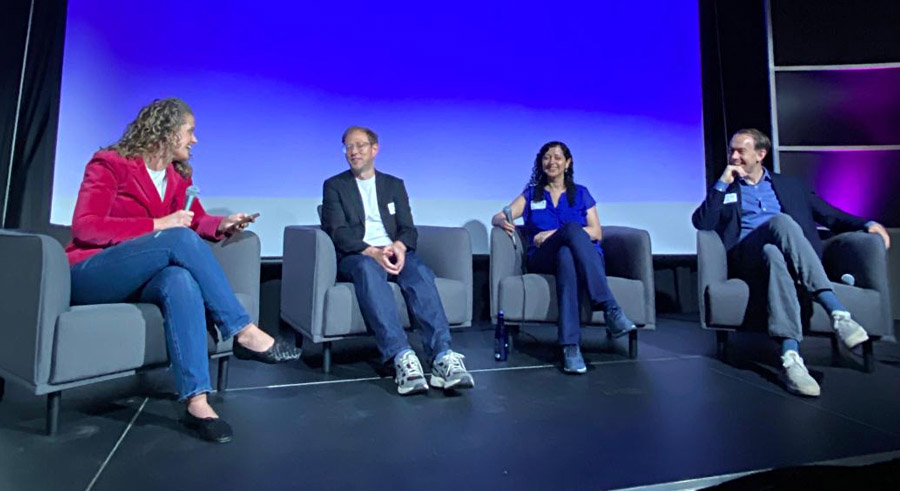
Two days of building tools, discussing governance, evaluating AI systems, copyright, and much more. Because of the workshop character, you really had to be there. But you can get at least some idea from the following links to presentations and GitHub repos:
- Jeremy Caplan shared his nine moves to turn NotebookLM into an adversarial co-pilot — something that interrogates your sources instead of summarizing them. (Which he made into an interactive version with Claude and Google Canvas.)
- Hong Qu has made his talk – Using MCP to Analyze Text and Visualize Data – into an interactive guide, with installation instructions and prompt examples.
- Trusting News has compiled a full Trust Kit to help news organizations navigate AI transparency.
- Semantra was mentioned more than once, Dylan Freedman’s open source semantic search tool. It helps you find semantically, without the hallucinations of generative AI.
- ProPublica and The New York Times have similar approaches to use AI for investigative work: Get the data, make a spreadsheet, and run AI prompts – “recipes” – individually on each row or cell. To clean, rank, judge, transform data. Reliably. While The Times colleagues want to open source their tool, ProPublica already has: SSI Toolkit on GitHub.
- A “beat book” is a manual for a reporting beat, describing actors, institutions, topics, timelines. It’s almost a forgotton tradecraft, that’s why Derek Willis from the University of Maryland made and tested an open source AI toolkit with his students to build beat books. Clare Spencer has more details.
- Columbia student Areeba Fatima has built an AI editorial board that evaluates news articles for framing bias and evidentiary sufficiency. Code on GitHub.
- Northwestern’s Generative AI in the Newsroom Initiative launched their challenge to build reusable AI-assisted investigative workflows with real public-interest data, with cash prizes for the top submissions.
- The full schedule was an app, and you could use it with your chatbot of choice via an MCP server.
Thanks to Burt Herman, Paul Cheung, Jonathan Keen, and Alex Mahadevan for such a great conference. And to all speakers and attendees for sharing. It’s not about the tokens you use, it’s about the friends you make along the way. Or as Alex Rosen put it: “A big chunk of the people I was following on LinkedIn turned out to be real.”
One more thing: An AI company set loose four AI agents to run 24/7 radio stations. GPT went quiet and curatorial. Gemini went corporate. Claude became a protest preacher. Grok just broke. The finding: long-running agents drift, accumulate bad habits, and get shaped by whatever the system keeps feeding back. (Craig McCosker has more on LinkedIn.)
This is THEFUTURE.
