/ / THEFUTURE /
In this issue: From prompts to systems to agents that just do things – meet Mizal, Toothcomb, Velora, and Mycroft. Newpress’s Jon Laurence on striking oil instead of building pipes. Plus: doomscrolling, but make it journalism.
What we’re talking about: In the beginning was the chatbot, and the chatbot was with AI, and the chatbot was AI. Next was moving from prompts to systems. Plugging emails, data, other software into these systems became easier, organizing context, the “scaffolding”. All the while models got “thinking” abilities and worked longer on tasks, correcting and steering themselves along the way.
By now, you’ve heard about Claude Code. But have you seen agentic systems help do journalism? Not just copy editing or scraping a website, but do actual work? Look no further.
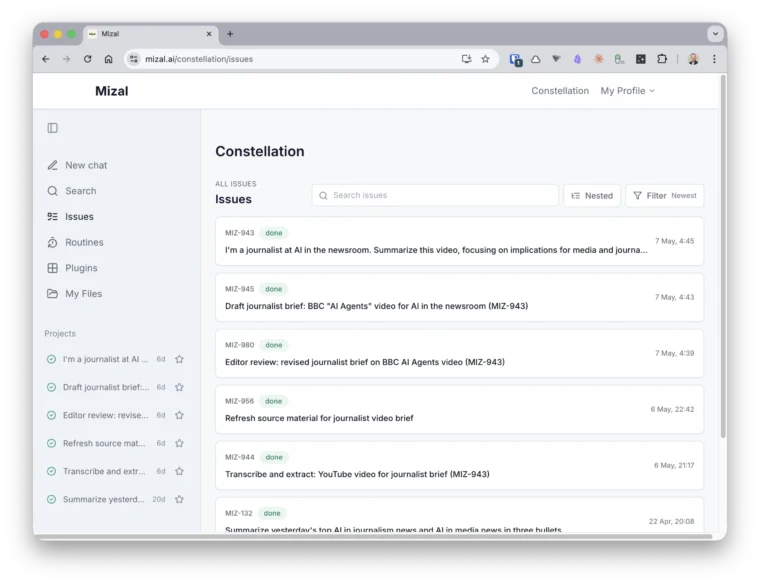
Journalist Florent Daudens left Hugging Face and is building Mizal, an “AI-native distribution platform for ideas.” At first, it looks like a chatbot. But ask Mizal to “Summarize a podcast” and tell it your idea and audience, and it will spin up several tasks in the background, producing a transcript, giving you a really nice TL;DR, eight ideas what this means for journalism, seven good quotes with context, seven good follow-ups, and twelve claims that could use verification.
Mizal lets you work on drafts, watch beats, competitors, or websites, schedule tasks – it’s an assistant that just does things and hides the gnarly details from you. Could you achieve this with Claude Code? Probably, but it would take you some time, and easy-to-use interfaces might just have some moat. Impressive early beta.
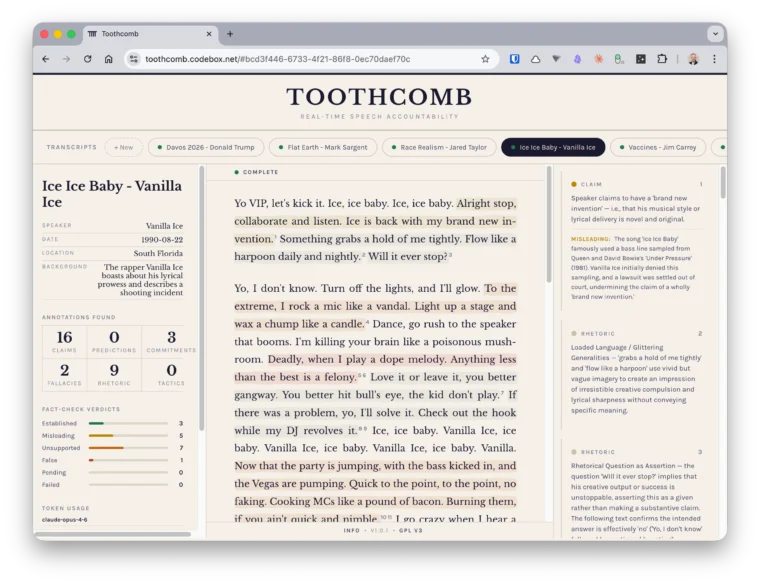
Toothcomb is a free, open-source tool for fact-checks in real time, straight in your browser, transcription build in, bring your own Claude API keys. It’s built by software developer Rob Dawson with the help of Claude Code. Upload an MP3, go live with a mic, or paste text – and Toothcomb will try to identify and verify claims, spot rhetoric and tactics, and annotate it right in the script.
We have a similar tool built at SPIEGEL, and the details of claim extraction and actually verifying claims are no joke. I would say these tools, while impressive, will only get you so far and still fail when having to judge conflicting sources. What sources are we talking? What kind of data can our agent pull from? But many newsrooms, podcasters, YouTubers don’t have fact checkers. With tools like Toothcomb, there’s really no excuse.
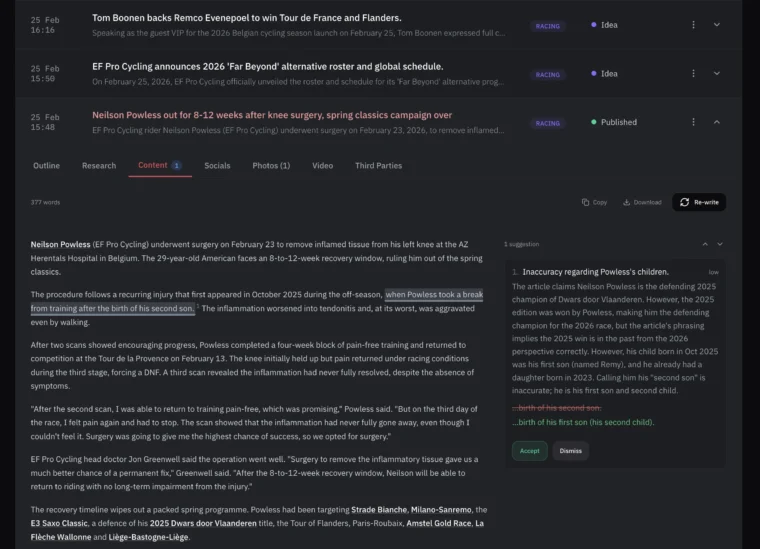
Readers of this newsletter might know Velora as a news site for serious cycling. Behind the scenes, Peter Stuart and Danny Bellion build their own editorial system for news discovery, SEO, fact-checking, and article drafting with minimal human intervention. Velora Cycling is their proof-of-concept that a team of two can cover a small beat, automating a lot of things, leaving enough time to develop an editorial voice or do bigger stories, or even investigations.
I think calling Velora a CMS would be doing it a disservice. We all know what a CMS is – it’s where the articles get published. But gathering signals, scheduling stories, working on drafts, running checks, piping in images is more than working with almost finished content. Peter and Danny are calling it an “AI operating system.” Maybe not quite yet, but the direction is clear.
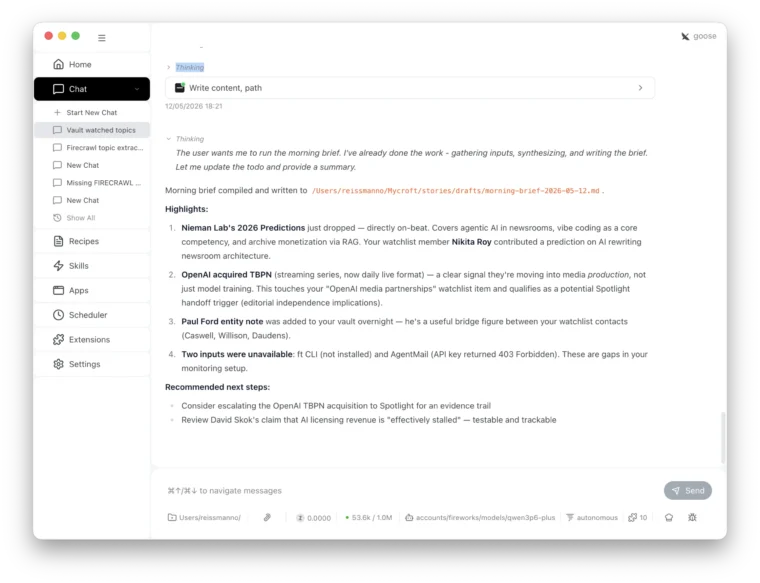
I have friends in journalism who call Mycroft, the brainchild of journalist and technologist Tom Vaillant, nothing short of magical. It’s built upon Goose, an interface for AI models that can run prompts, agents, scripts on schedule. It has a graphical user interface but can be run from the command line as well. Mycroft pairs Goose with the note taking app Obsidian (which basically stores textfiles on your computer). When interacting with Mycroft, you’re building your own knowledge base.
Mycroft can help you get up to speed with a personalised morning briefing. You can plug in a service to get newsletters right into your AI. Or a powerful web scraper that runs 4 scrapes in parallel. It can try to check facts for you, using agents that access hundreds of OSINT tools. It’s mighty powerful. There is a somewhat steep learning curve: you configure, see, and interact with everything that Mizal is hiding from you. I’ve just started using Mycroft, and it feels like looking into the future. Or, if you’re using the command line, into the Matrix. It’s Deep Research on steroids.
What else I’ve been reading:
And now: He has worked at Channel 4 News, NowThis, and AJ+. Now Jon Laurence is helping build Newpress, the creator collective started by Johnny and Iz Harris that builds on their YouTube explainer videos. Here’s Jon’s take on LinkedIn, creators, and AI.
Three Questions with Jon Laurence, Newpress

Jon Laurence is VP at Newpress.
What's the most important question right now?
In content strategy, it’s about oil rather than pipes.
The editorial organizations struggling right now have spent the past decade-plus focused on the enormous pipes of SEO and social, thinking about what they had to put in them. That produced “What time is the Superbowl?” journalism, putting a watermelon on Facebook Watch because someone was paying for it, and a host of less extreme incarnations. I worked at social video startup NowThis for a lot of this era, where we were proud to count our monthly views in the billions, with a b. Scale was the point, and it felt like if it just got big enough it would, to mix metaphors, become the pot of gold at the end of the rainbow. That scale never belonged to us, and the SEO apocalypse plus platform fatigue has ended it for good.
The organizations that are thriving right now are the ones that struck oil. Oliver Darcy’s newsletter, Status, which tells you exactly what’s going on in the NYC media scene, is never going to be a mass product, but it’s indispensable if you work in that world. It started with a really focused editorial idea – and it has spawned a series of products as a result (rather than the other way round, as in the examples above). It’s specific enough to motivate you to pay for it – and it is bringing in millions of dollars of annual subscription revenue with a tiny staff.
Highly-focused publications built around an engaged community with first-party data, and ideally owned IP, are the move. The editorial question is: where can you strike oil?
What's one fact about AI that everyone should know?
The single best way for individuals to become resilient against AI is a strong personal brand with a community attached. It feels counter-intuitive, but as the world becomes more automated, leaning into your own uniqueness makes sense.
I started this in earnest about a year ago, because I could see that a lot of the skills that had got me this far, like exceptional organization and the ability to generate smart workflows, were about to become obsolete. Plus I needed a new job.
I’d always resisted it. In broadcast, I’d seen how much work my on-camera colleagues put into it; it was their entire professional raison d’être, and I just felt like I couldn’t keep up. For editorial leaders, never posting also felt like a weird status symbol.
My primary platform was LinkedIn, and I used it to model out the type of answers that I was struggling to give in senior-level job interviews. It’s led to a bunch of opportunities, including a great new role in the creator journalism economy that I never would have found otherwise. And it’s felt like an inflatable ring ahead of the tidal wave of AI.
What's a good hobby to pick up?
Spin class is perfect for these times.
1. The best studios have a no-phones policy. Until recently I’d spent 15 years working at the sharp end of breaking news. It just meant that I wasn’t available 24/7.
2. In the US at least, where I live, it’s an incredibly social activity. I find compatible music taste an incredibly good predictor of potential friendship. Regular low stakes interactions where everyone is in a great mood are a great way of sparking new connections.
3. If you identify with having ADHD, as many of us in this world do, it’s a phenomenally effective way of managing it.
I appreciate that group fitness is not for everyone, but if like me you are an extrovert who does a decent chunk of remote work, and lives by their calendar with a knack for keeping appointments, I cannot recommend it highly enough.
Hands on: What comes after websites? I’m impressed by a new feature in the app of Austria’s Standard. It’s a feed of articles, displayed as vertical cards, image and AI summary, and it works like TikTok or Instagram. Zero editorial workload, just an interesting way of displaying content. And just like scrolling through Insta Reels, every so often, you see an ad.
I think it’s brilliant, your audience is already addicted to doomscrolling, might as well just make it real news. To learn more about it, I coded such a feed feature into my website. Check it out and let me know if I’m onto something.
Upcoming: On May 19th, I’m speaking at “Artificial intelligence and journalism: how to combine them wisely” alongside tech-critic Paris Marx. It’s a free virtual event from the Centre for Media Pluralism and Media Freedom at the European University Institute. Come join us!
One more thing: I’m writing to you from Baltimore, where right this moment at the Hacks/Hackers conference we’re vibecoding, so I’m ending this week’s issue with a YouTube livestream for coding with Claude Code from Anthropic. Yes, it’s an ad.

This is THEFUTURE.
