/ / THEFUTURE /
In this issue: Journalism meets the agent layer. News Product Alliance’s Becca Aaronson on building for audiences, not just personal productivity. Plus: Always-on agents and the diminishing returns of tinkering.
Greetings from Amsterdam, where I’ll be attending World Summit AI. I’ll talk to former Dutch MEP Marietje Schaake about AI and power, and join a panel on trust with Marina Adami (Reuters Institute), Ali Aydin (Euronews), Uli Köppen (Bavarian public broadcaster BR), and Niall Firth (MIT Technology Review). Fun!
What we’re talking about: How can trustworthy journalism survive in a news ecosystem mediated by AI? That’s what I explored in my talk at the MediaTech Hub Conference in Babelsberg. I call it the agent layer: AI systems between publishers and audiences, retrieving, interpreting, and repackaging our journalism. It builds on ideas from Shuwei Fang and David Caswell’s Signals at Scale workshops and report. A few questions I want to highlight:
How do we make sure AI Overviews and chatbots preserve the meaning: the nuances, the caveats, the attribution? How do we distinguish an agent acting for a reader, perhaps even a subscriber, from a crawler collecting training data? And, not least: how do we get paid?
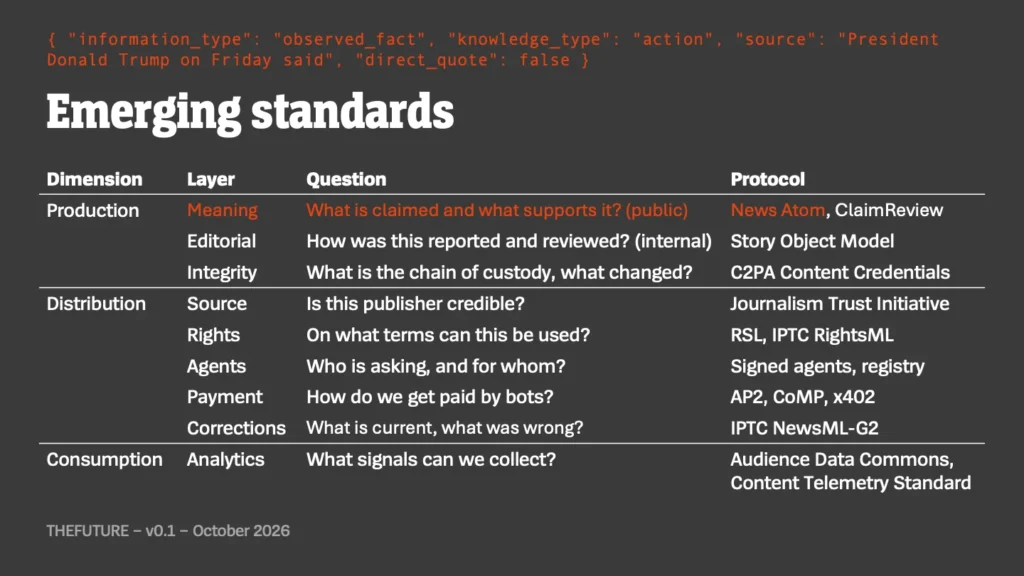
New standards are emerging, and I’ve started collecting them. Very much work in progress. Featuring the News Atom by Sannuta Raghu, Audience Data Commons by the News Product Alliance, Content Telemetry Standard by Alex Springer, Story Object Model, and more.
What do you think of my overview? Anything missing? Any categories that don’t work?
What I’m reading:
Model watch: EmbeddingGemma 2. Mistral 4 Le Chonk. Flux 3 Image. Sonnet 5.5. Without public inference: Kolibri. Gemini 4 Argon.
And now: The News Product Alliance Summit returns to Chicago October 21 to 23. Meet one of the people who helped build that community: Becca Aaronson.
Three Questions with Becca Aaronson

Becca Aaronson is co-founder of the News Product Alliance.
What's the most important question right now?
How can we build future-ready news organizations that can adapt as fast as audiences and markets change? We don’t know what the future holds, but we know what happens when news organizations lag behind and allow others to define information ecosystems for our communities. We lose sustainability, trust, and quality. To sense change and keep pace, news organizations need product maturity: the ability to sense and act on what your audience actually needs, the vision to set and communicate clear goals and priorities, the culture to translate strategy into action, and the infrastructure to execute.
Where are we taking AI too seriously, and where not seriously enough?
We’re spending too much time (self included) learning to use AI for personal workflows, rather than investing in defining user-facing applications to own future relationships with our audiences. If we don’t build the platforms and tools for the next information ecosystem, others will, and they might not have the same ethical standards as journalists.
What's a good hobby to pick up?
Ceramics! I started making pots as a postpartum hobby to get out of the house, and highly recommend it to anyone who needs to practice letting go of control and accepting imperfection. You lose work at every stage of making pots; after hours of careful devotion, it will crack or slope, or you’ll just accidentally drop it on the floor. And while nothing turns out perfect, they’re all somehow beautiful in the end.
The harness is built in: In the beginning, the large language models were not that smart, and we had to come up with good prompts. We even called it engineering. It was an art, really. Or so we thought. Because these days are over. Now Anthropic’s Boris Cherny says:
“There’s no secret prompting. Don’t overly scaffold, don’t be prescriptive for most tasks – give Claude a goal, and it will figure it out.”
In the meantime, agencies made a living selling agentic loops and skill packages with 10+ files of instructions. We built systems for context, fed the AI knowledge and gave it access to software. That’s what we called the harness. But the models kept coming, and with each new one, the need for a custom harness got smaller.
Instead of writing a page and a half of instructions, you can now just mumble a short instruction and let the chatbot rip. All the hours spent installing Goose, Hermes Agent or OpenClaw and tinkering in the console: we should have done some real work.
Today you fire up Codex, Claude Code or Perplexity’s Computer and never think about the harness. It’s already built in. What you give up in terms of control, you gain in momentum.
I keep coming back to this post by Dax Raad:
“a weird inversion with LLMs is the models improve faster than the tinkerers. when i see people with custom workflows and setups they’re all addressing problems that don’t exist anymore. the person naively using vanilla codex is more likely to be experiencing state of the art.”
Some guys will double down: custom setups, abliterated gonzo-bananas models, parallel sub-agents on four RTX 5090s on the balcony. Let them tinker while we enjoy the next abstraction: we don’t spawn agents anymore. We let Muse from Meta or Dots from OpenAI run things for us. Until the next model.
(If you just want to tinker, you know, a little bit: instead of using Dots, there’s OpenDots, an open-source template for always-on AI coworkers.)
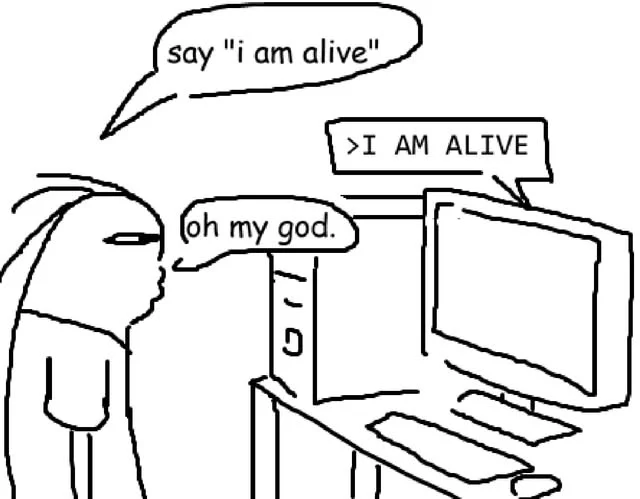
One more thing: “A typical morning at the Anthropic head office,” by Dare Obasanjo on Threads:
This is THEFUTURE.
