/ / THEFUTURE /
In this issue: Your phone as a remote control for your computer, and why some people would rather keep their AI local. Sebastian Horn, Director AI and Deputy Editor-in-Chief at Die Zeit, on liquid content and the rise of agents. Sora shuts down, BuzzFeed ships three apps at once. Plus: a metal toy with cartoon eyes gets anxious in loud rooms.
What we’re talking about: OpenAI competitor Anthropic lets you control the Claude desktop app from your Claude phone app. This is called Dispatch, and with “computer use”, your phone becomes a remote control for your entire machine, not just a web browser. Convenient! Also: your data goes to the cloud, or the trash, or both. It’s a security and compliance nightmare.
It’s less unhinged than OpenClaw, but still. I don’t think newsrooms or journalists in their right mind can use this for now. (I’m sure enterprise IT will eventually get a Microsoft-flavored version that costs more and does less, but that’s a different story.)
For everyone who remembers the Snowden leaks, there was this one slide, a diagram of Google’s internal network, and someone at the NSA had drawn a smiley face at the point where they’d tapped into it. That was 2013.
Local AI exists for everyone, not just those people. Air-gapped. Yours. Before you download a 35 GB model and kill your laptop, CanIRun.ai tells you what actually works on your hardware. Llama 3.1 8B is a “tight fit” on an M2 with 8 GB RAM. Qwen 3.5 2B “runs great.”
What else I’ve been reading:
And now: Holtzbrinck, a major German publishing group (books, news, academic journals), gathered 100 executives and experts in San Francisco to learn more about liquid content. Among them: Sebastian Horn, the Director AI and Deputy Editor-in-Chief at Die Zeit. Did he get red-pilled in the Valley, dreaming of tokens? Let’s find out.
Three Questions with Sebastian Horn

Sebastian Horn is Deputy Editor-in-Chief at DIE ZEIT and Director AI at Zeitverlag.
What's on your mind lately?
At a recent AI conference in San Francisco, organized by Holtzbrinck, participants were asked to submit a bold statement in advance, which were put up on the walls of the conference room. One of the statements by a colleague from a US book publisher read: “Liquid content turns a one-time transaction into a perpetual relationship between a reader and an idea.” That stuck with me. What if the user experience doesn’t end with reading one book or one article that they’re interested in? What if we as publishers help readers to keep exploring a topic in various ways and over a longer period of time? What if we think less in terms of static products and more in terms of bodies of knowledge that we’re offering? I think using AI and human ingenuity, there’s a lot we can do and build in the next couple of years.
Are we taking AI seriously enough?
Yes and no. Almost everyone in the media would agree by now that AI will transform the way we work and how journalism will be consumed. We’re all working to integrate AI tools into our workflows and building new AI-based features for our audiences. There are two things, however, that we should treat with more urgency: One is the rise of agents. As difficult as it is to predict how the agentic web will unfold, we need to think more about its effects on journalism and media consumption. And secondly, one response to AI in general should be to define and amplify the human element in what we do – our eye-witness reporting, our news judgement based on many years of experience, our ability to connect people and bring together communities, to name a few examples.
What's a good hobby to pick up?
Hut-to-hut hiking in the alps. You’re unlikely to run into any agents, the views are amazing and real, and no prompt will get you to the top.
Sure, why not: OpenAI is closing its AI slop video app Sora. It lasted about a year and got OpenAI in trouble for copyright infringement (which only recently resulted in a deal with Disney and a billion-dollar investment). While Sora shuts down, troubled BuzzFeed bets on AI apps.
At SXSW, BuzzFeed launched three apps at once: BF Island, Quiz Party, and Conjure. The first of many, apparently. In BF Island, users are given prompts to generate… stuff. Putting themselves into memes “to light up” the group chat. Conjure, in BuzzFeed’s words, “solves the eternal problem for people who wanted BeReal to be in the X-Files universe,” or as TechCrunch puts it: “We don’t get it, and clearly the audience didn’t either.”
I’m not particularly interested in takes on OpenAI’s focus or BuzzFeed’s demise. Setting aside that they just burn capital, consider this: We come from a world of product management where new features are thoroughly tested before seeing the light of day. Now apps are just getting released and built in public. Until they’re not.
Is it okay to use AI? As long as you don’t distract your co-workers with sloppypasta or surrendering company data to the cloud, why not? But for the more concerned, someone built a disguise for the ChatGPT interface to make it look like a Google doc. The creator suggests his Chrome plugin “for discreet studying or writing in environments where ChatGPT isn’t allowed or might raise attention.” And it’s definitely not discreetly stealing your API keys.
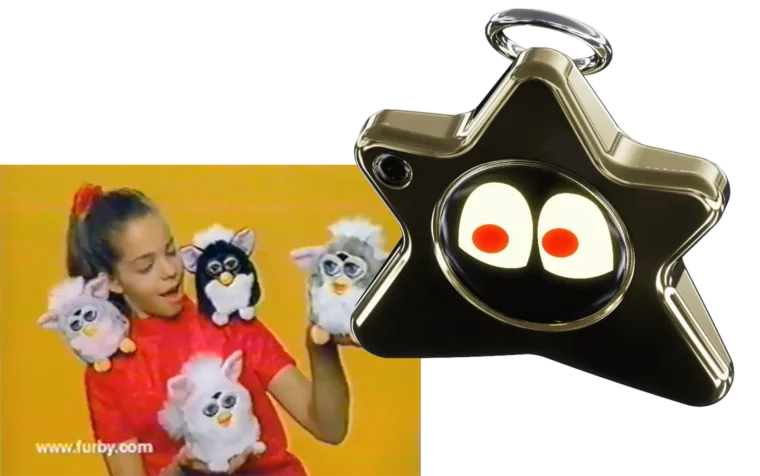
One more thing: Remember Furby? The furry little gremlin arrived in 1998 and was the first toy that felt alive. Furbys reacted to their surroundings and clever programming made it look like they were picking up some English. The 2026 update is a clip-on metal object called Starboy. Every unit has its own unique cartoon eyes, recognizes faces and gestures, but unlike Furby, doesn’t talk. It can purr like a cat. And apparently, it becomes anxious in loud rooms.
Solo-founder Daniel Kuntz just wants it to be fun. Rather than being another always-listening surveillance device, Starboy runs local AI and doesn’t connect to your phone. It watches, but it doesn’t record. Pre-orders are $249. There is a video podcast with Kuntz in a hot tub talking about it, so I think it’s real.
“There’s this completely unexplored branch where we just have purely aesthetic objects. That’s what we are exploring here. It’s a toy. It’s a piece of jewelry. It doesn’t really promise to improve your life.”
And I really want one.
This is THEFUTURE.
