/ / THEFUTURE /
In this issue: Sloppypasta is everywhere and we need to talk about it. Tokyo Broadcasting System’s Emiko Kawabata on what happens to journalism when AI becomes the gateway to information. A tool for image verification. And: a Chrome plugin for people who just want the text.
What we’re talking about: Have you heard of Sloppypasta? Do you have a Sloppelgänger? We’re getting sludged. Dull, boring AI output left and right. Sloppypasta everywhere.
Now, I have some reservations with slapping “slop” on anything that doesn’t sound like an Ivy-league education or that I just don’t like. It has classist undertones, as Advait Sarkar has noted. Lamenting second-hand thinking is getting old fast.
We had bad copy before AI. Empty marketing texts, speeches that hit a few keywords without saying anything at all. It’s the sheer volume of slop that is concerning. The audacity of coworkers or even friends (or shall we call them: former friends?) to rub it in your face.
While we should not punish people for wanting to sound more professionally versed or fluent in a foreign language, we can also uphold good taste and manners (yes, I’m that old, talking about manners now. Thanks, AI.)
Don’t be a slopper. Fight sloppypasta.
What else I’ve been reading:
And now: The media world is changing, quickly. Emiko Kawabata decided to take a break and figure this out, moving from Tokyo to Helsinki for an Executive MBA. She wrote about Schibsted’s approach to AI platforms, which LinkedIn surfaced. Back in Tokyo now, I’m glad she took the time for three quick questions.
Three Questions with Emiko Kawabata

Emiko Kawabata is a journalist and media executive at Tokyo Broadcasting System.
What's the most important question right now?
The most important question right now is not simply how to use AI, but where journalism stands when AI increasingly becomes the gateway to information.
For years, news organisations have reached the public by reporting, editing and distributing stories. But more people may soon skip search engines and news homepages altogether and ask AI directly: What happened today? What does this mean? That changes how news is discovered, framed and valued.
Having worked in television news, I see this as something much deeper than a workflow upgrade. The real challenge is how journalism preserves editorial judgement, trust and relevance in an AI-mediated information environment.
Are we taking AI seriously enough?
Not yet.
Many media organisations are already using AI for transcription, summarisation, translation and other practical tasks. But too much of the conversation still stops at efficiency.
AI is not just a newsroom tool. It is starting to reshape the routes through which people encounter information. Who gets seen, what gets surfaced, and in what context it is understood may all change. Media organisations need to treat AI not only as a productivity issue, but as a structural shift in the information environment.
What future are you looking forward to?
I’m not most excited about a future where AI simply helps us produce more content, faster. I’m looking forward to a future where journalism reaches people better — including those who may have felt distant from news until now.
At its best, journalism helps people make sense of complexity, see what matters, and notice what might otherwise remain invisible. In an AI-mediated world, that role may become even more important.
What gives me hope is the possibility that trustworthy journalism can reach more people, more naturally, without losing its public purpose.
Hands on: Copy the text of a website to do something – that’s still a daily task for me, even in the age of webscrapers, AI agents, remote controlled browsers. I just need the text, fast. And there is a Chrome plugin that does it very well: Obsidian Web Clipper. It’s a companion to Obsidian, a knowledge management tool where you store text files. Some people hook it up with Claude and become galactic super brains. But! You don’t have to use Obsidian. Just use the Web Clipper to copy an article into your clipboard to do ~whatever~.
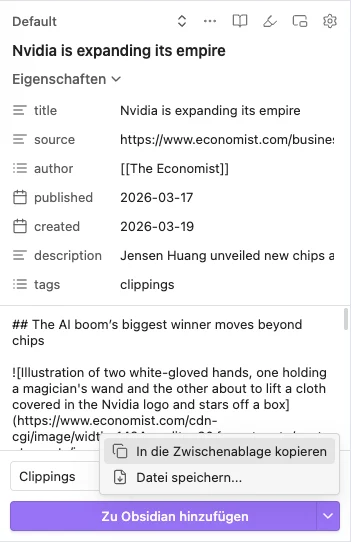
You can tell Web Clipper what kind of information to capture. You could also give it access to your AI with an API key, and the clipper will identify, capture, and modify the content for you. I do neither. I just use it as is. No subscription, no ads, no tracking. And it works beautifully.
Changelog: Now that we can build everything, the better question is: “but should we?”
Yes, you definitely should build an airhorn into your website to accompany quotes.
One more thing: Can you tell which passage was written by AI? This New York Times quiz is humbling either way.
