
The Agent Layer: My Keynote at Mediatech Hub Conference 2026
I was invited to speak at the Mediatech Hub Conference in Babelsberg, Potsdam. Here’s my script, more or less what I said on stage, and some links.

Hi, thanks you for having me.

Let’s start with a shoutout: Next week, “Droneland” starts streaming on Telekom’s MagentaTV. It’s set in a near future where artificial intelligence watches everyone. One of the directors studied here at the Film University Babelsberg. And the book it’s based on was written by Tom Hillenbrand, a friend and former colleague of mine.
Now, let’s talk about AI. My version is a bit less dramatic.
My name is Ole, I work at SPIEGEL in Hamburg. I’m the Director of AI, which means people ask me “Have you tried this new model?” And no, I probably haven’t, because who can keep up these days?
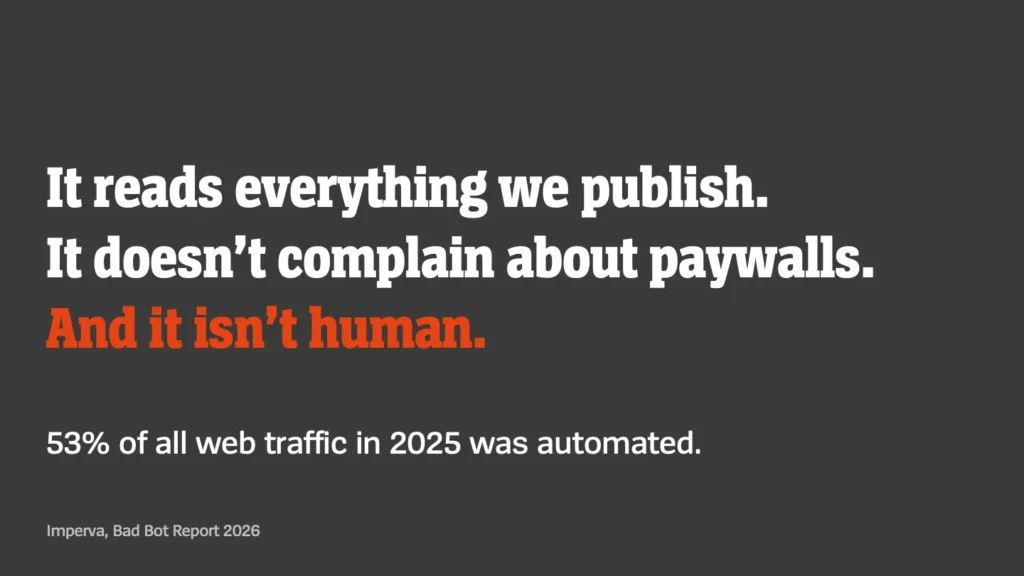
Today I want to talk about a new audience: It’s growing fast, it reads everything we publish, and never complains about a paywall. And it’s not human.
Last year, more than half of all traffic on the web was automated.
We’re talking bots, crawlers, agents. Software that searches, reads and acts on behalf of a person or a company. There is a new layer between publishers and readers.
I’ll talk about three things. Where we come from, what is happening now, and where I think we can find our place.

Where we come from.
When ChatGPT arrived, most media companies did what companies always do with new technology. We asked: how can this make our work faster or cheaper? Transcription, translation, summaries, headlines, text to speech. Some of it is starting to work.
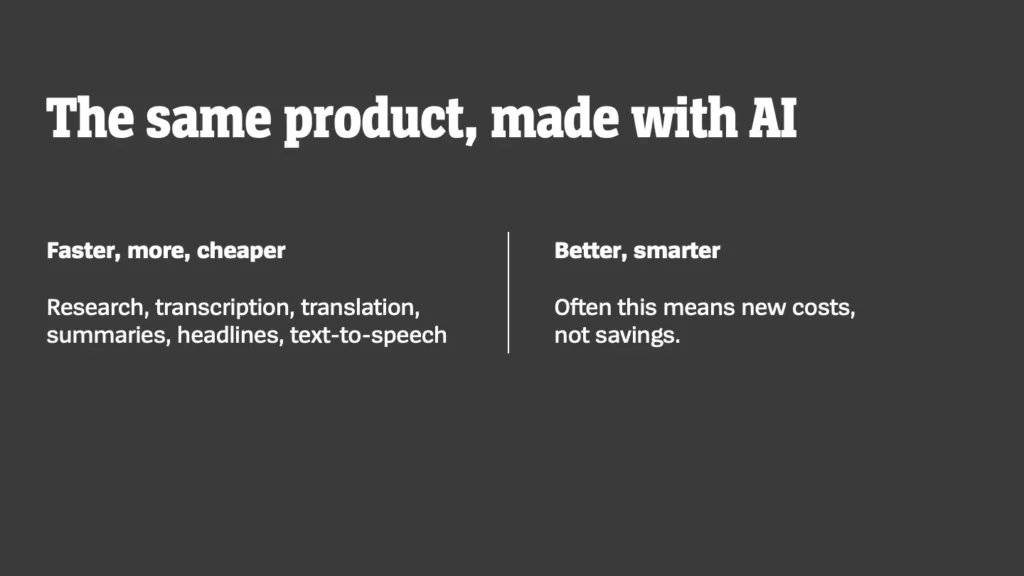
We take the product we know, the article, the video, the podcast, and we make it – with the help of AI.
And then we say: don’t worry, there’s a human in the loop. We have written it into our guidelines at SPIEGEL. But it answers a question about production. And I’m starting to think that production is not the most important question.
Because while we are busy improving the old product, the audience is moving somewhere else.
So where are they moving? Let’s call it the agent layer.

AI is becoming the thing between us and everything else. It’s in the phone, in the browser, and soon in our glasses. No, not mine. I chose a transparent frame for a reason.
You don’t open ten websites anymore. You ask. Plan my trip. Compare these offers. And if you’re me, tell me what happened in the Bundestag today. And one morning, your agent greets you with news about something you searched for two weeks ago.
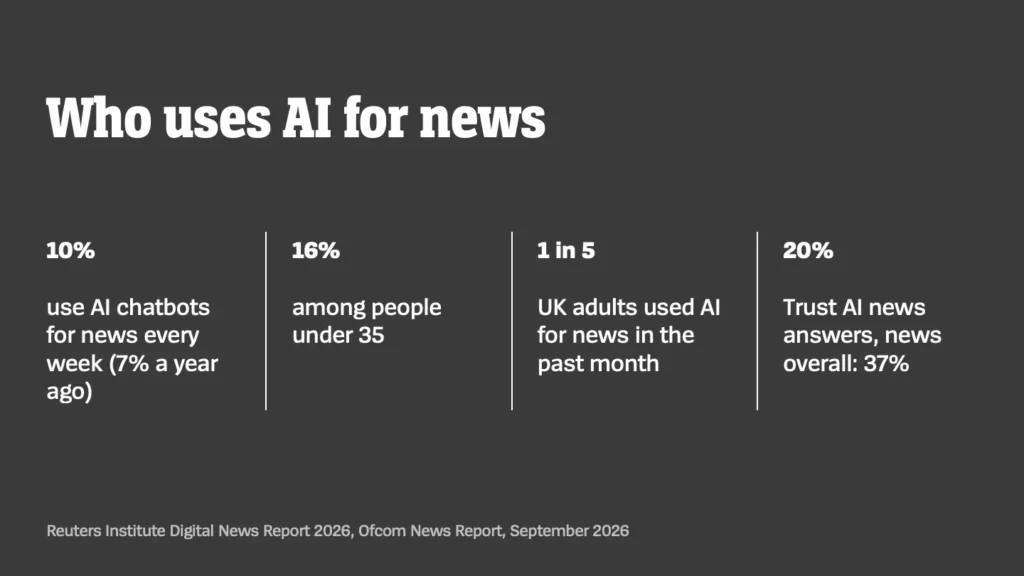
How many people use this for news? Still a minority, but it’s growing. Two weeks ago, Ofcom reported that in the UK, one in five adults used AI for news in the last month. And even if you don’t want AI, Google Search is becoming AI Mode. Take that.
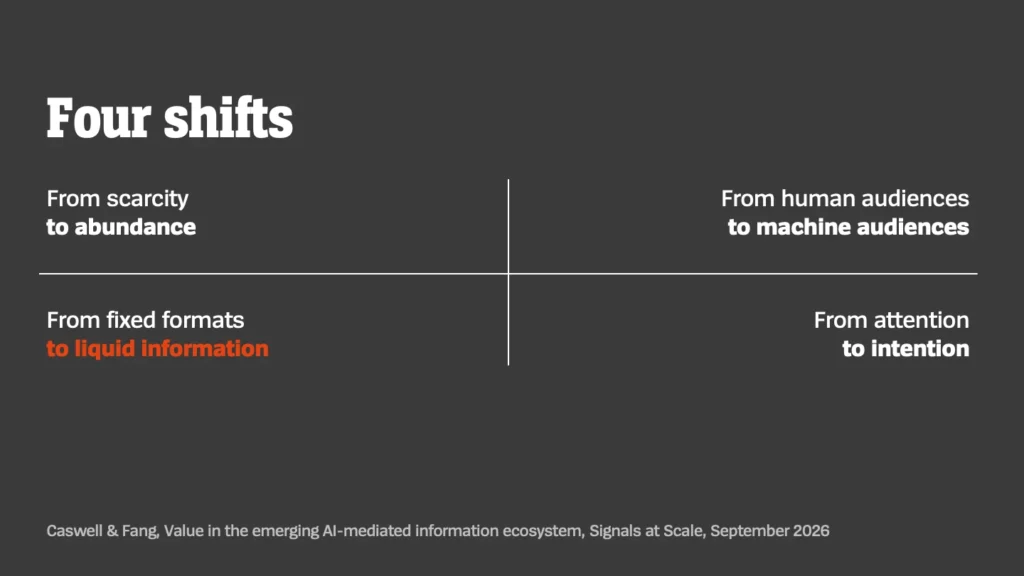
I was lucky to take part in one of the Signals at Scale workshops, a series about exactly this ecosystem. The report describes four shifts. From scarcity to abundance. From human audiences to machine audiences. From fixed formats to liquid information. And from attention to intention.
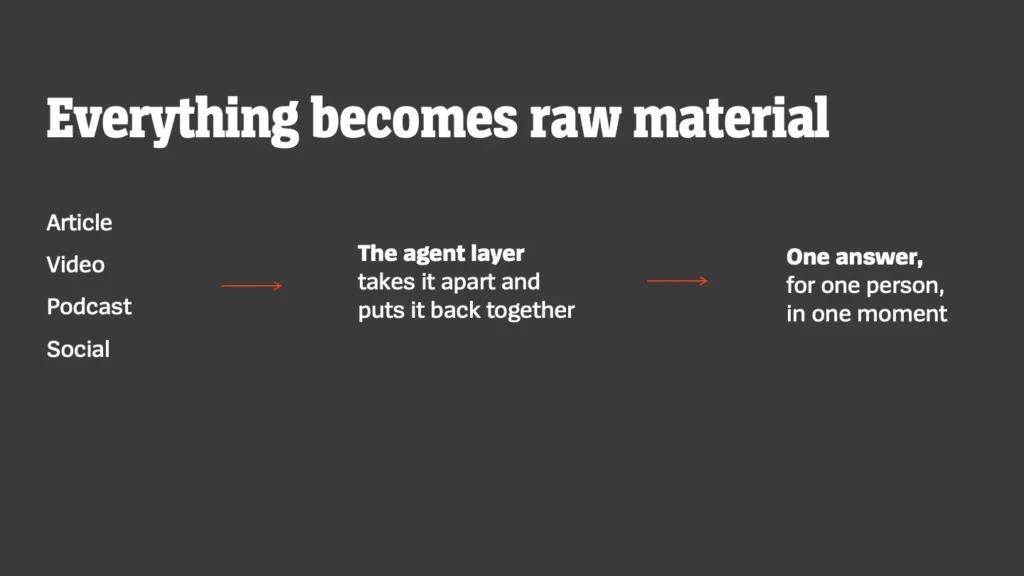
Let’s look at the fixed format: An article, a video, a podcast, a series: for an AI system, it’s all raw material. It takes it apart and puts it together again, for one person, in one moment. That’s true for my news story. The same layer that summarizes my article will decide which show gets recommended, and which show gets a two line summary instead of a viewer.
And when producing things gets very cheap, which it will, the value moves. Away from the thing we make, to the place where people ask their questions. The demand goes to the AI layer, not to our brand.
And for publishers, there is the fear of Google Zero: the day search sends us no traffic at all. We’re not there yet, especially not in the German market. But it’s happening.
So what do publishers do? Mostly three things. We block, we sue, we license. None of them is enough. But let’s start with blocking.
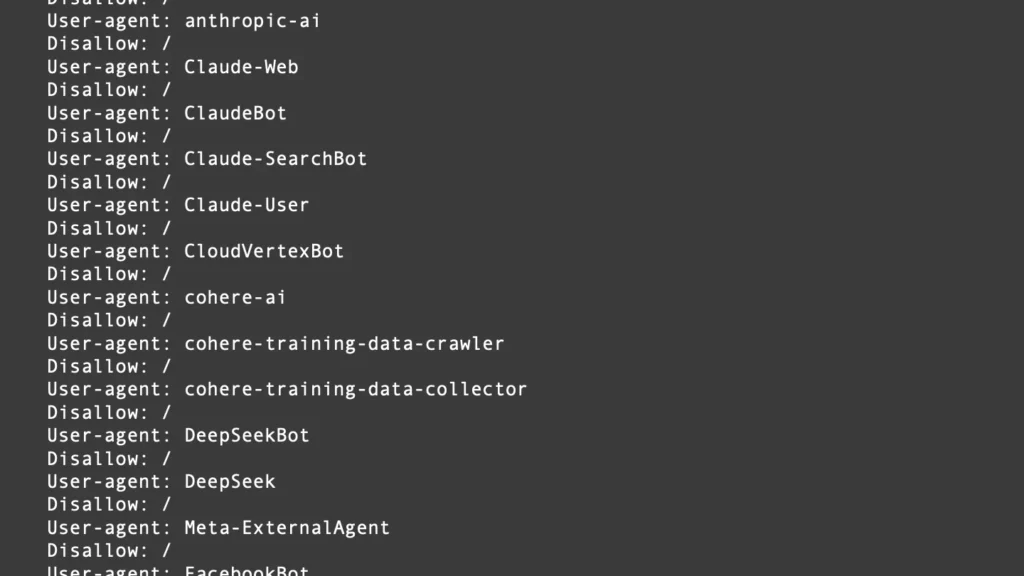
Blocking bots is only easy in theory. You put a small text file on your website, robots.txt, and it says: please don’t. And the bot reads it. Or not. It’s basically a polite sign on the door.
And many don’t read it. TollBit found that at the end of last year about 30 percent of AI scrapes ignored the rules in robots.txt.
So publishers build stronger walls. Bot checks, fingerprinting, captchas: “please click on all the traffic lights.” And who clicks on the traffic lights? Our subscribers.
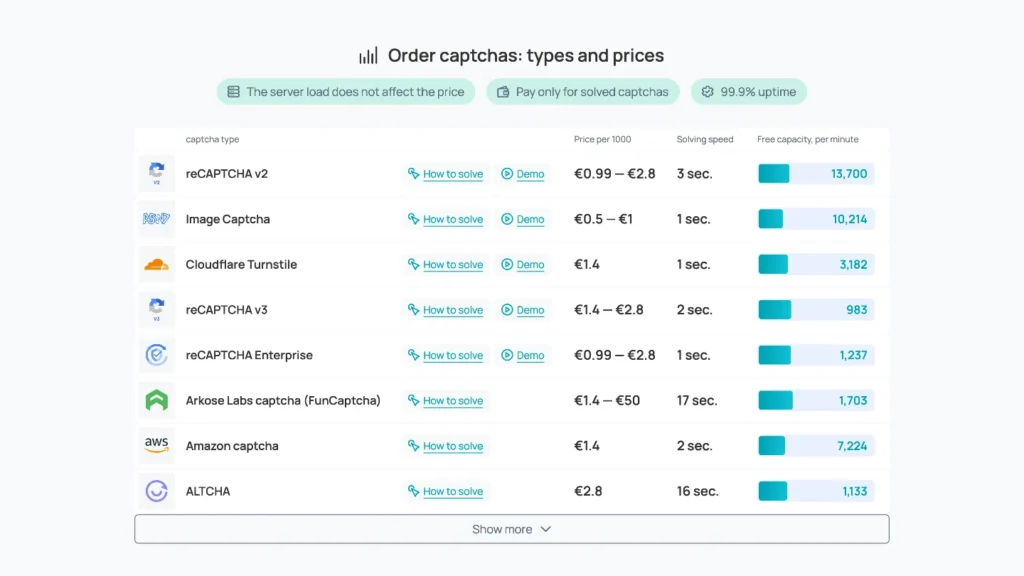
And bots, because there are services where a bot solves the puzzle. With bot blocking, all you really do is raise the price of crawling.
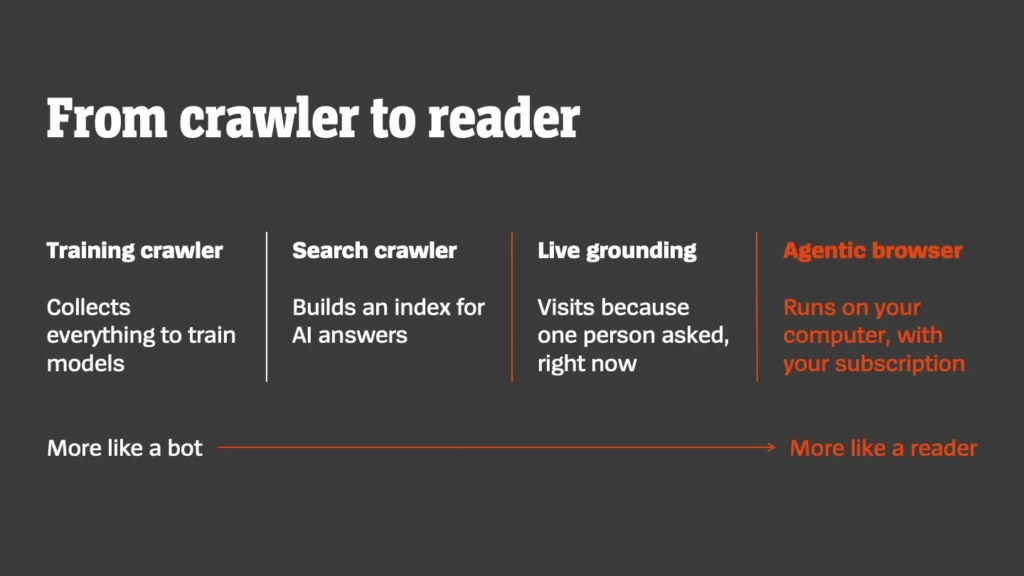
And there’s a more basic question: what is a bot, actually? There are crawlers that collect everything to train models. There are crawlers for AI search. There are tools that visit our site only because one person asked one question, right now. And there are agents that run in the user’s own browser, on their own computer, logged in with their own subscription. The one they pay for.
Is that a bot? Or is that a reader?
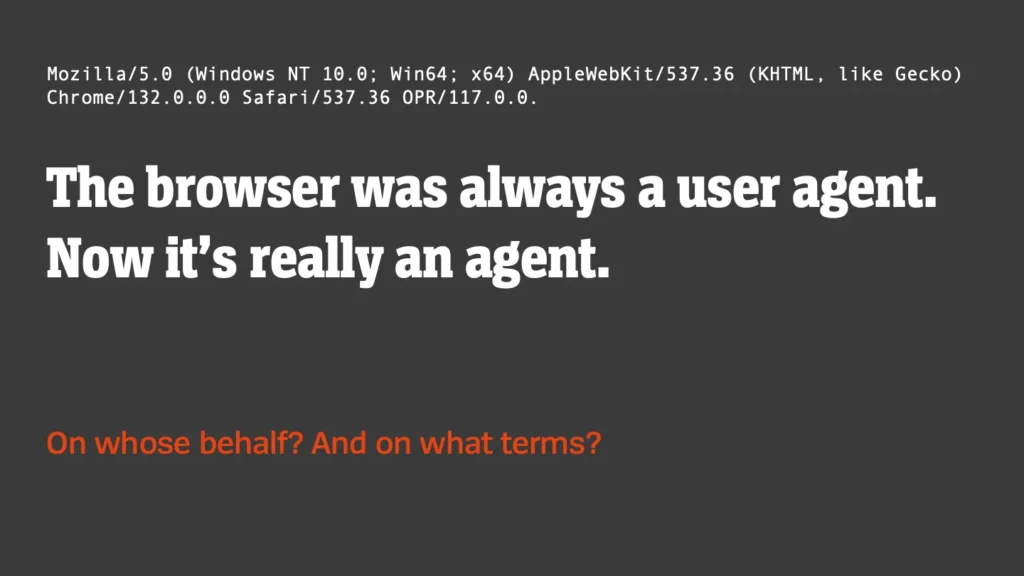
The browser was always called the “user agent.” Software acting for the user. It’s written in every request since the nineties. Now the user agent really is an agent.
I think “bot or human” is the wrong question. The better question is: on whose behalf? And on what terms? I’ll come back to that.
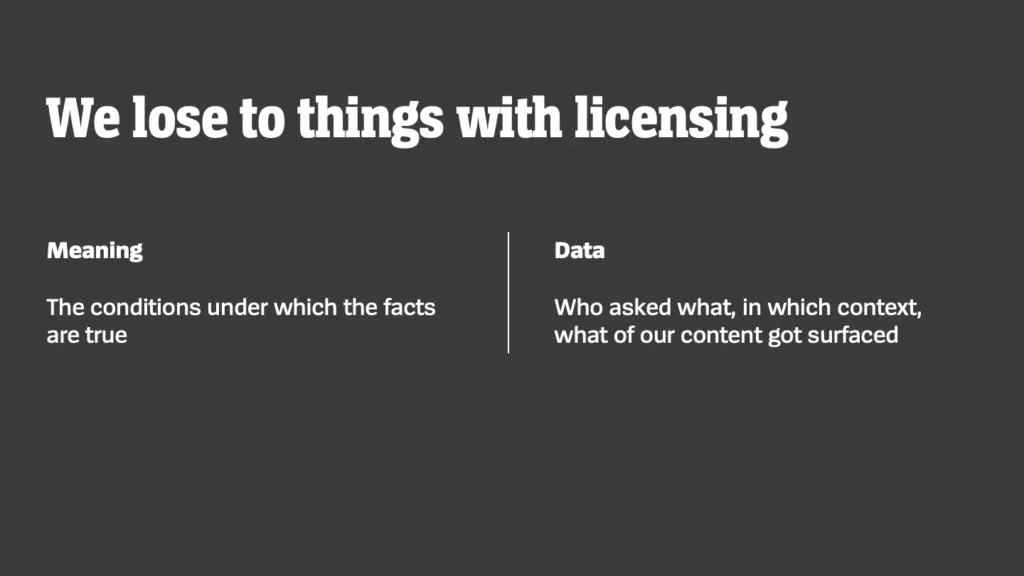
Now, licensing. Some publishers have signed deals, and that’s good. Money, right? But if the deal is “here is our content, here is a check,” we lose two things.
The first is meaning, and with that, in the end: trust. Volker Bach mentioned “information integrity”. Well, here we go.
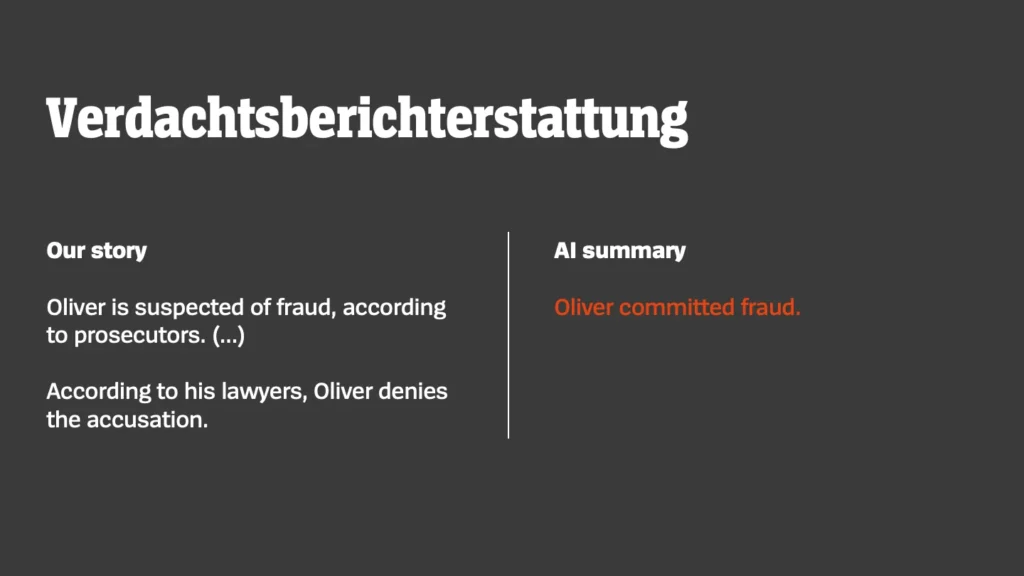
Sometimes, in journalism, every single word matters. In Germany we have strict rules for reporting on suspicions. There’s a truly German word for it, Verdachtsberichterstattung, and I’m sorry about that. When we report that someone is suspected of something, we have to make clear it’s a suspicion, we have to include their side, and we argue with our lawyers over every sentence.

Now an AI makes a summary. The “allegedly” falls out. The statement from the other side falls out, because it was in paragraph six, and who reads paragraph six. And suddenly the summary says something we never said. Something we would never be allowed to say.
The second thing we lose is data.
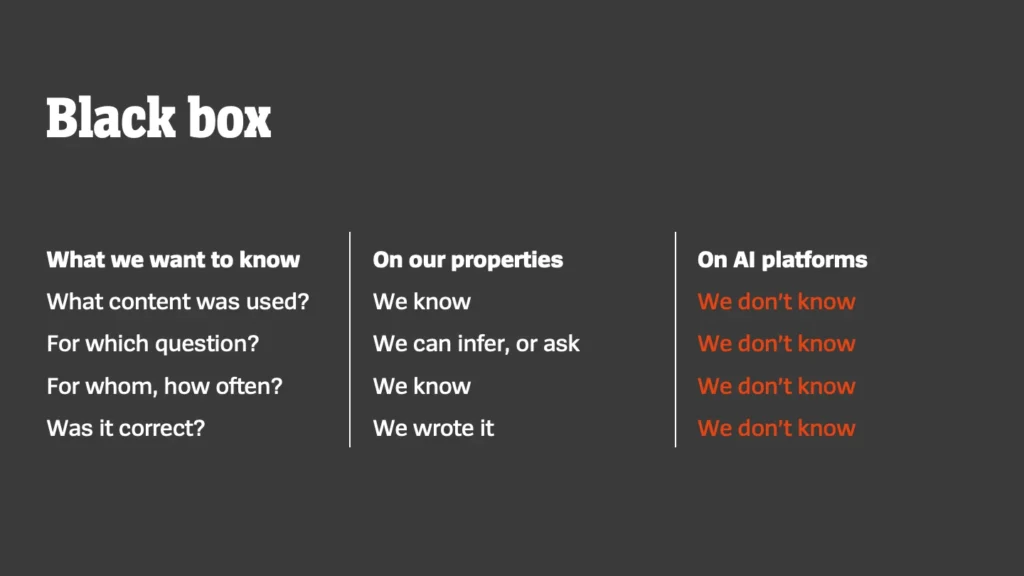
On the web, we always knew a little about our readers. Not as much as Meta or Google, but okay. Which article, from where, how long, who subscribed afterwards. We run our newsrooms with that. With a license, we get a check and a black box. We don’t know which questions our journalism answered, how often, for whom, next to which other sources.
And this is not only true for publishers. I’ve heard that streaming platforms initially didn’t tell producers how their shows performed. You delivered, you got your fee, and good luck. Publishers are now signing the same kind of deal with AI companies.
But the AI platforms have the best audience research that ever existed. A search query was two or three words. A prompt is the user’s need, and more. But they’re asking AI, not us.

Okay. That was the depressing part. Let’s try to find our place.
Let’s think about who captures the value. This is again from the Signals at Scale workshop: Often, it’s not publishers anymore, but the AI layer. The AI layers knows the content and intent of the user, it controls the interface, it might have their payment information.
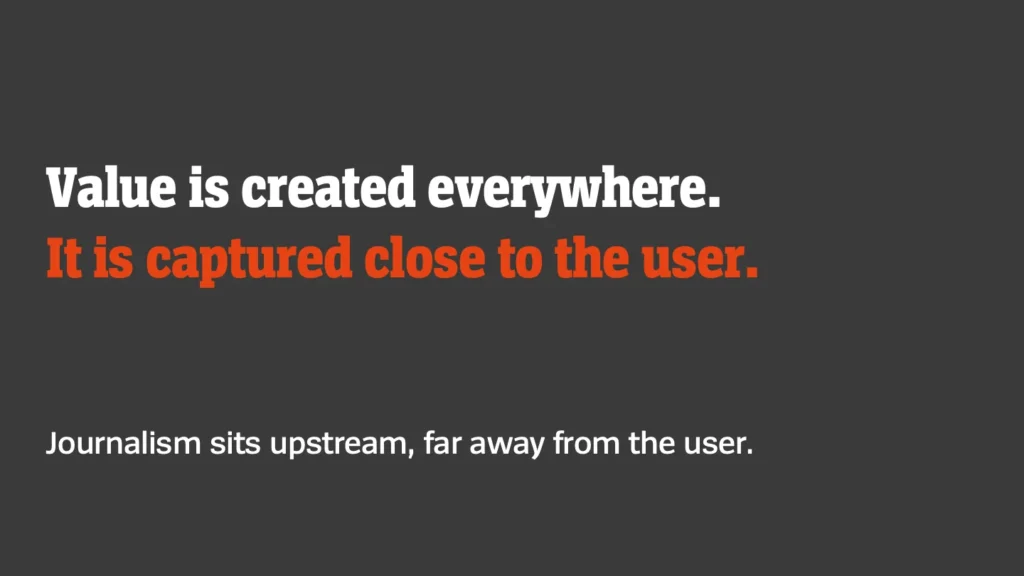
So value is created everywhere, but it’s captured close to the user. And journalism sits far away from the user. Upstream.
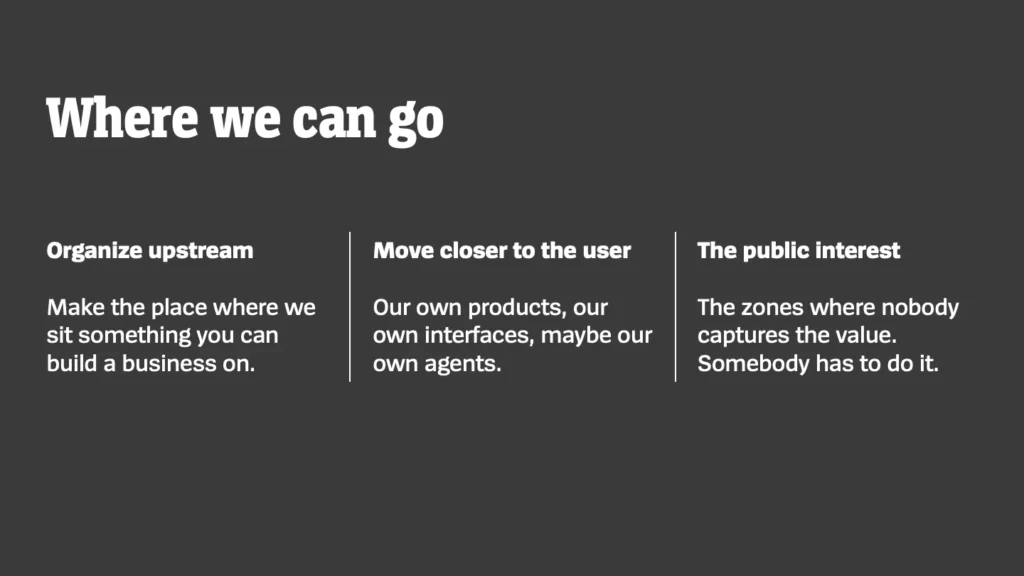
I see two moves. The first: organize upstream, so that the place where we sit becomes something you can actually build a business on. The second: move closer to the user again, with our own products, our own interfaces, maybe our own agents. And there’s a third job, maybe for public service media, in those zones where nobody captures the value: drafting standards, investigations that don’t attract subscribers but are of value for liberal democracy. Somebody has to do it.
Now, how can we deal with bots? What do we need?
First: identity.
If we want to engage with bots, then agents need to tell us who they are.
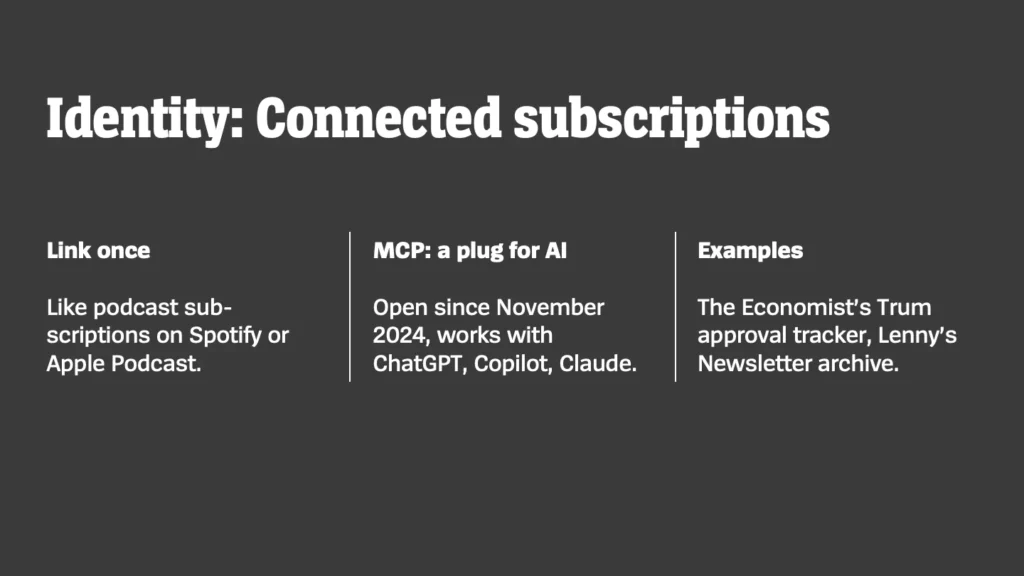
There is a simple way: connected subscriptions. You tell your AI that you have a subscription, and you link the accounts, like you can with podcast subscriptions on Spotify or Apple Podcasts.
The technology for this exists: OAuth and MCP, the Model Context Protocol. This works for existing users.
But let’s face it, most people don’t have a subscription, at least not yet, and if we want to have a way of being discovered or stay visible, we have to give the agents something.
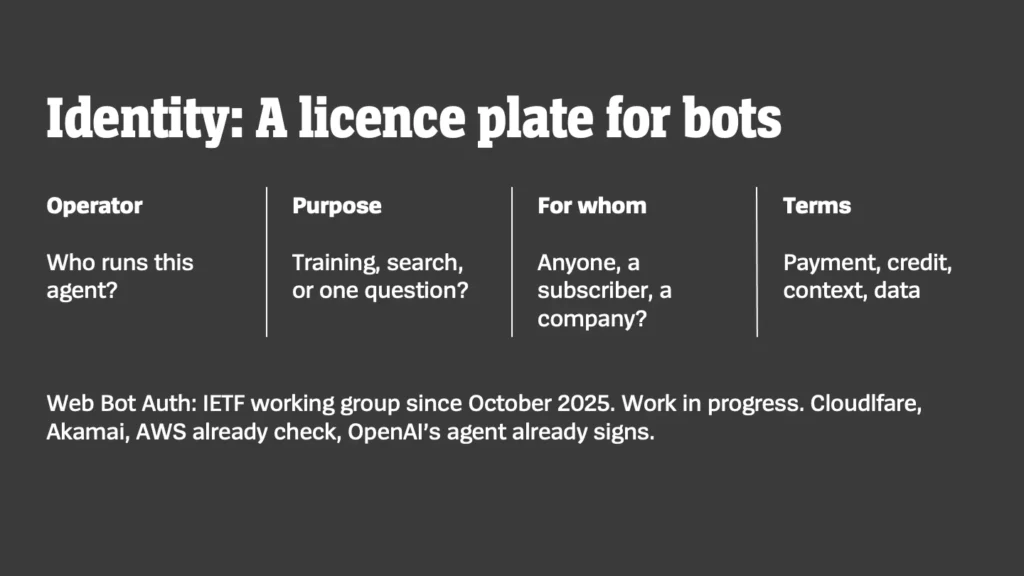
So: who runs this agent? Basically, a registry for agents. A license plate.
There is already work on this. It’s called Web Bot Auth. The company behind an agent publishes a key, and every request carries a signature. So you know who it really is, not just who it claims to be. There’s been a working group at the IETF since last October. The standard isn’t finished yet, but Cloudflare, Akamai and AWS already check these signatures, and OpenAI’s agent supposedly signs.
Second: provenance and meaning.
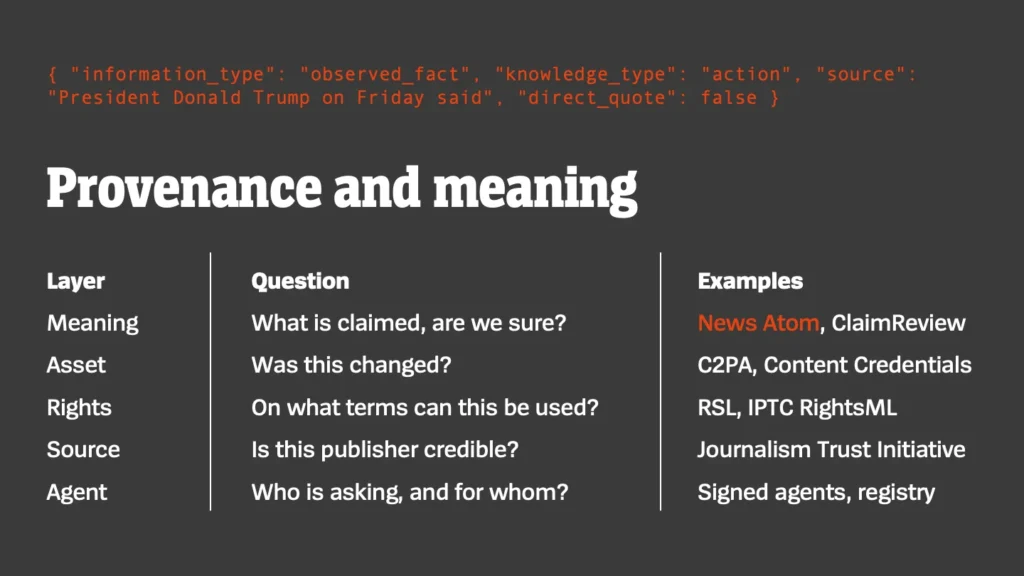
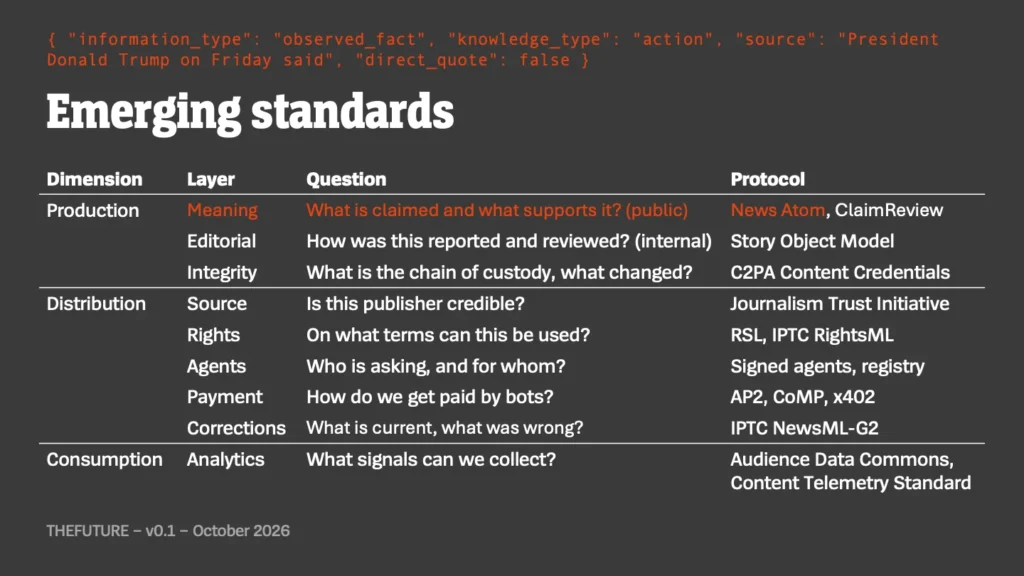
There are tools already. C2PA, or Content Credentials, for text, images and video. Many broadcasters in this room use it.
Then there’s RSL, Really Simple Licensing. robots.txt says yes or no. RSL says: yes, under these conditions. Search yes, AI search no. Pay per crawl. Pay per answer. Credit us. More than 1,500 organizations support it, including AP and the Guardian. But RSL can’t block anyone on its own. It needs someone like Cloudflare or Akamai to enforce it.
And the News Atom gives every sentence or claim in a story its own metadata.
The problem is that these layers don’t really talk to each other yet. And the layer for meaning is the least developed: Today we can prove that a photo was not changed. With a sentence, it’s not that easy. I hope nobody brings up blockchain.
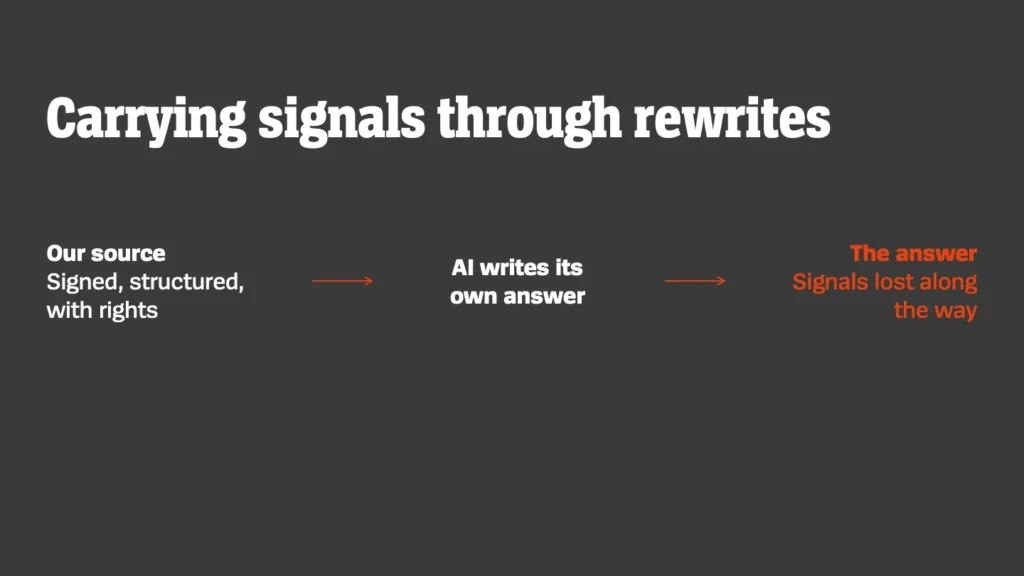
There’s an even harder problem. An AI takes our content, but then it writes its own answer. And the signals don’t come along.
So we will need some new rules. Every sentence in an answer should point to the source it’s based on. Some things only travel together: the accusation and the reply. And maybe the simplest rule of all: if the source says “allegedly,” the answer says “allegedly.” Certainty can go down on the way. Never up.
For newsrooms, this might be a new kind of editorial work. Not only “is every word correct?” but “what has to survive when a machine rewrites this?” But we have to convince AI platforms that this is useful, even necessary, and that they have to pay for it.
Third: data and payment.
Every deal should come with reporting, not only with money. What was used, how often, in which context. And if agents access our journalism through our own interface, an API or an MCP server, then we can see what they are asking for.
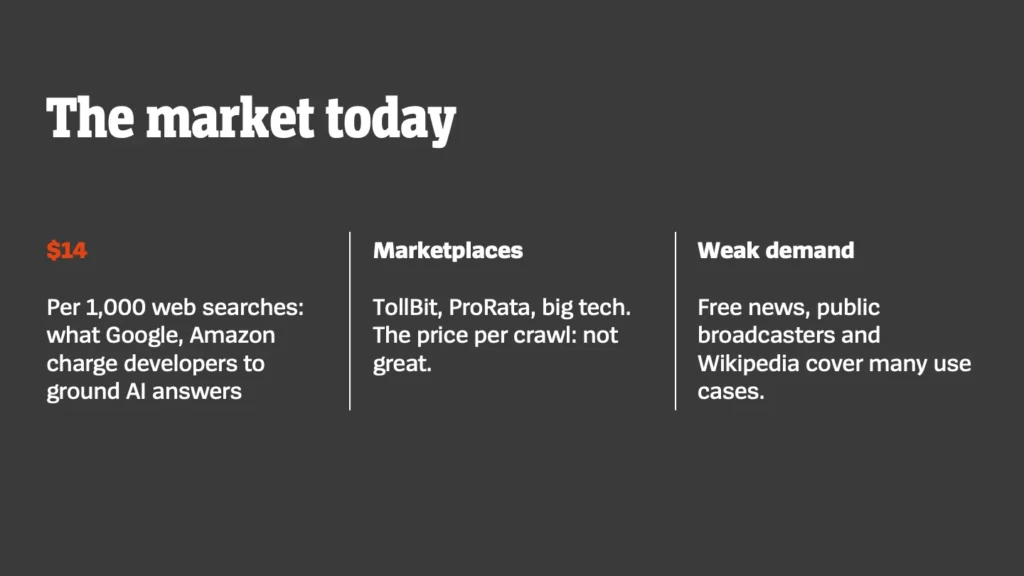
Payment is a bit of an issue, though. Most publishers have long resisted letting users pay per article, and for good reason: the economics just don’t work when you run a newsroom of hundreds of people.
Some companies are building marketplaces right now. There are industry players like TollBit or ProRata, and there are the big tech companies. Let’s just say: the money offered per crawl is not great. And the demand side has not really shown up yet. As long as there is free news, from reach-driven sites, from public broadcasters, from Wikipedia, a lot of use cases work fine without paying publishers.
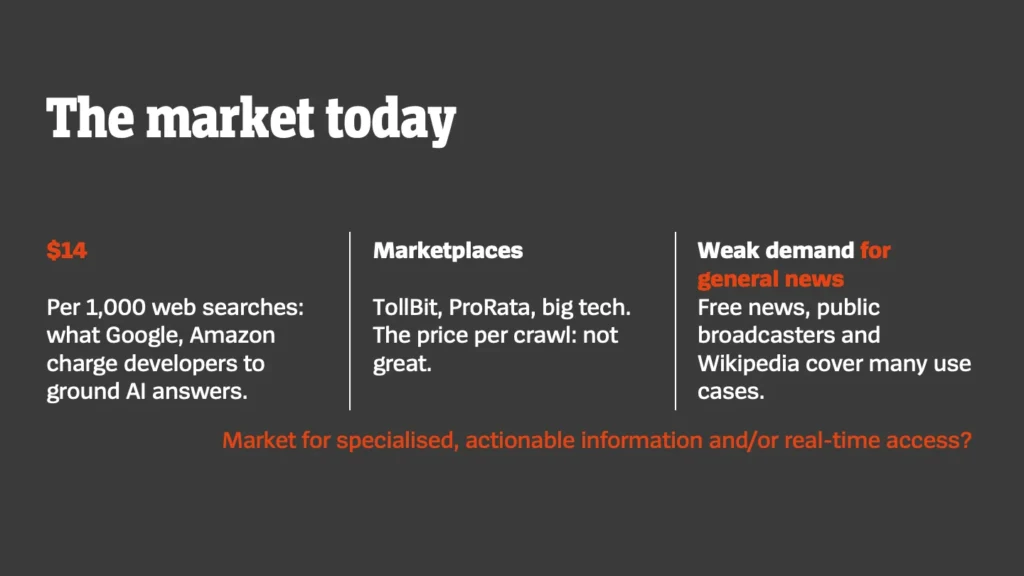
I have to add: Paying works at least for highly specialised, real-time information, for example Bloomberg.
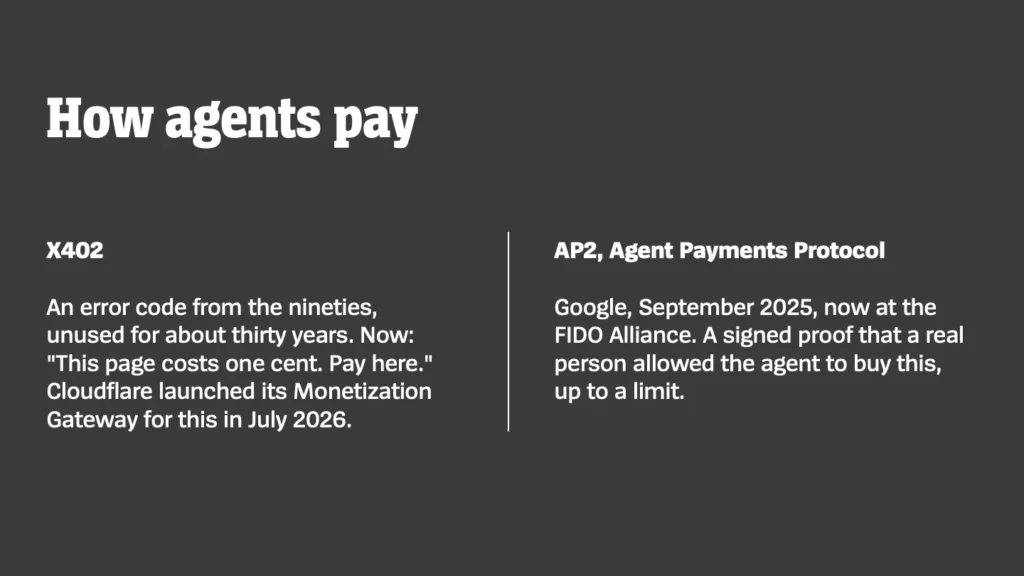
Then there’s the technical side. There’s an error code in the web from the nineties: 402, Payment Required. A website can answer a bot: “this page costs one cent, pay here.” Cloudflare launched a service for this in July.
And there is AP2, the Agent Payments Protocol. The idea: the agent carries a signed proof, a “mandate,” that a real person allowed it to buy this, up to a limit.
By the way, did you notice a name that keeps coming up? Cloudflare. They block the bots. They check the signatures. And now they handle the payments. Blocking, identity, payment: this is the infrastructure of the agentic web. It’s a new ecosystem. And new man in the middle.
From what I’ve seen, we have a tiered system right now. Some publishers get deals, a lump sum of money, and smaller ones are left out, probably to compete for pay per crawl. But it’s early days.
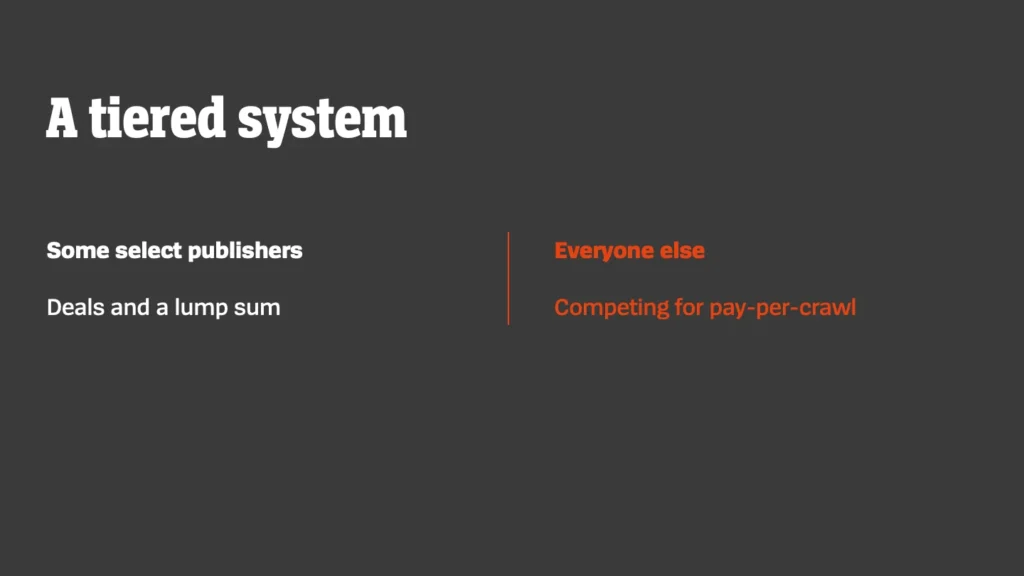
And the biggest winner so far is not a publisher. Amazon reportedly pays the New York Times 20 to 25 million dollars a year. Reddit reportedly gets about 60 million a year from Google and about 70 million from OpenAI. The New York Times has 175 years of journalism and a newsroom of 2,000. Reddit has people asking and answering questions, in their own words.
We’ve seen this before, in music. First, everything was free, on Napster. The labels sued. Then Apple came with 99 cents per song. It was better than free, because it was more convenient. And today it’s subscriptions. The money goes to the platforms, to the delivery, to the technology, some of it to the music industry. And the artists get cents.
And what are publishers doing right now? Locking the content, blocking the bots. At least for now. That’s why I advocate for thinking through these challenges together.
That’s why initiatives like the SPUR coalition matter, and standards bodies, and yes, also regulation.
That’s it.
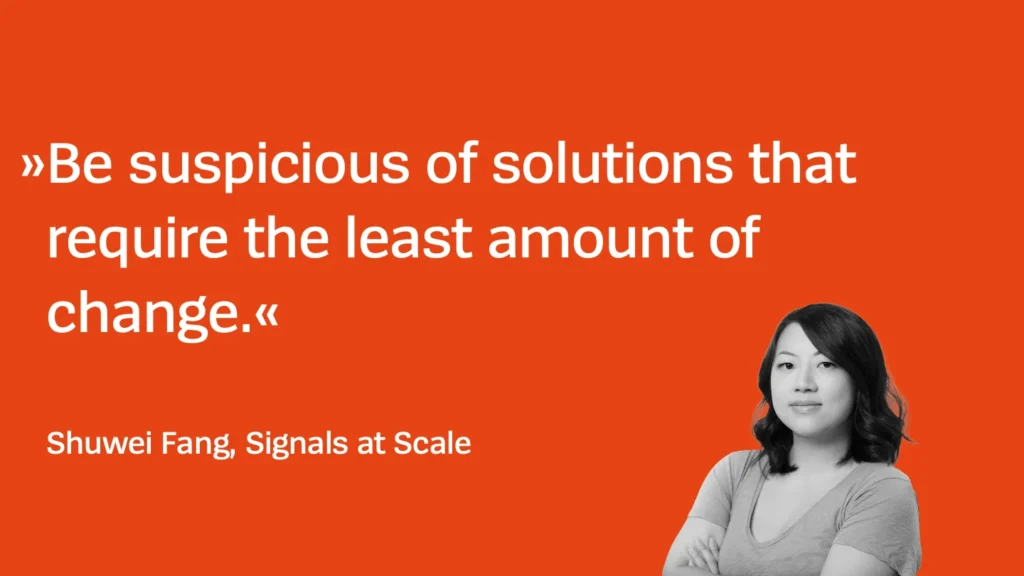
Shuwei Fang has a sentence I keep coming back to: be suspicious of solutions that require the least amount of change. Blocking, suing, licensing: they all require very little change from us.
Telecom companies have a name for their biggest fear: the dumb pipe. You carry everything, and somebody else makes the money. You’re right, full circle, we’re back promoting “Droneland” on Telekom’s streaming service.
Journalism is needed, maybe more than ever. So let’s build the layer. Or we become the pipe.
Thank you.
I wrote this myself. Claude helped translate it from German into English and tighten it to fit a 20-minute slot. Pangram will flag it as AI-generated.
Header image copyright MTH Conference | Andrea Hansen.
