
9 Real AI Use Cases from the Hacks/Hackers Journalism Summit 2026
300 journalists, developers, and media folks gathered for two days at The Real News Network offices in Baltimore for workshops, vibecoding sessions, talks, and eventually karaoke. Rubina Fillion (New York Times), Ryan Struyk (CNN), and I kicked off the conference with a panel, exquisitely moderated by Heather Ciras (Boston Globe).
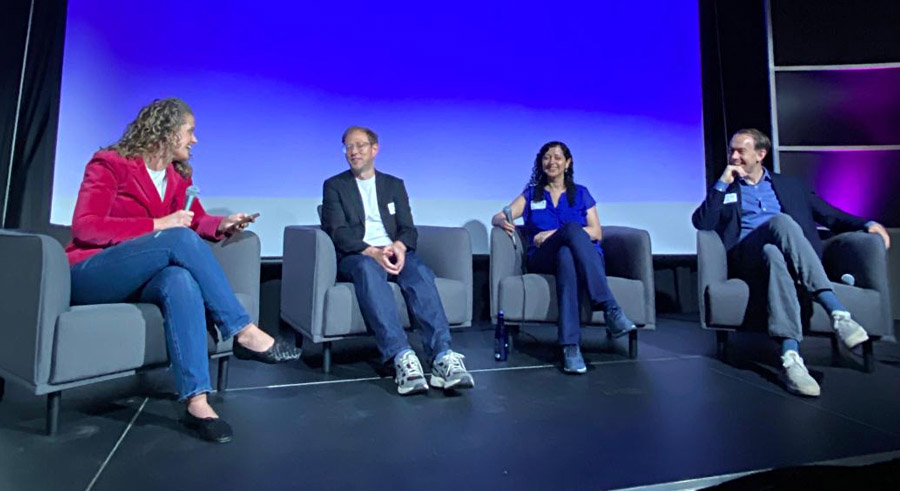
Two days of building tools, discussing governance, evaluating AI systems, copyright, and much more. Because of the workshop character, you really had to be there. But you can get at least some idea from the following links to presentations and GitHub repos:
- Jeremy Caplan shared his nine moves to turn NotebookLM into an adversarial co-pilot — something that interrogates your sources instead of summarizing them. (Which he made into an interactive version with Claude and Google Canvas.)
- Hong Qu has made his talk – Using MCP to Analyze Text and Visualize Data – into an interactive guide, with installation instructions and prompt examples.
- Trusting News has compiled a full Trust Kit to help news organizations navigate AI transparency.
- Semantra was mentioned more than once, Dylan Freedman’s open source semantic search tool. It helps you find semantically, without the hallucinations of generative AI.
- ProPublica and The New York Times have similar approaches to use AI for investigative work: Get the data, make a spreadsheet, and run AI prompts – “recipes” – individually on each row or cell. To clean, rank, judge, transform data. Reliably. While The Times colleagues want to open source their tool, ProPublica already has: SSI Toolkit on GitHub.
- A “beat book” is a manual for a reporting beat, describing actors, institutions, topics, timelines. It’s almost a forgotton tradecraft, that’s why Derek Willis from the University of Maryland made and tested an open source AI toolkit with his students to build beat books. Clare Spencer has more details.
- Columbia student Areeba Fatima has built an AI editorial board that evaluates news articles for framing bias and evidentiary sufficiency. Code on GitHub.
- Northwestern’s Generative AI in the Newsroom Initiative launched their challenge to build reusable AI-assisted investigative workflows with real public-interest data, with cash prizes for the top submissions.
- The full schedule was an app, and you could use it with your chatbot of choice via an MCP server.
Thanks to Burt Herman, Paul Cheung, Jonathan Keen, and Alex Mahadevan for such a great conference. And to all speakers and attendees for sharing. It’s not about the tokens you use, it’s about the friends you make along the way. Or as Alex Rosen put it: “A big chunk of the people I was following on LinkedIn turned out to be real.”
