Mizal, Toothcomb, Velora, Mycroft: Four Tools That Just Do Things
In the beginning was the chatbot, and the chatbot was with AI, and the chatbot was AI. Next was moving from prompts to systems. Plugging emails, data, other software into these systems became easier, organizing context, the scaffolding. All the while models got “thinking” abilities and worked longer on tasks, correcting and steering themselves along the way.
By now, you’ve heard about Claude Code. But have you seen agentic systems help do journalism? Not just copy editing or scraping a website, but do actual work? Look no further.
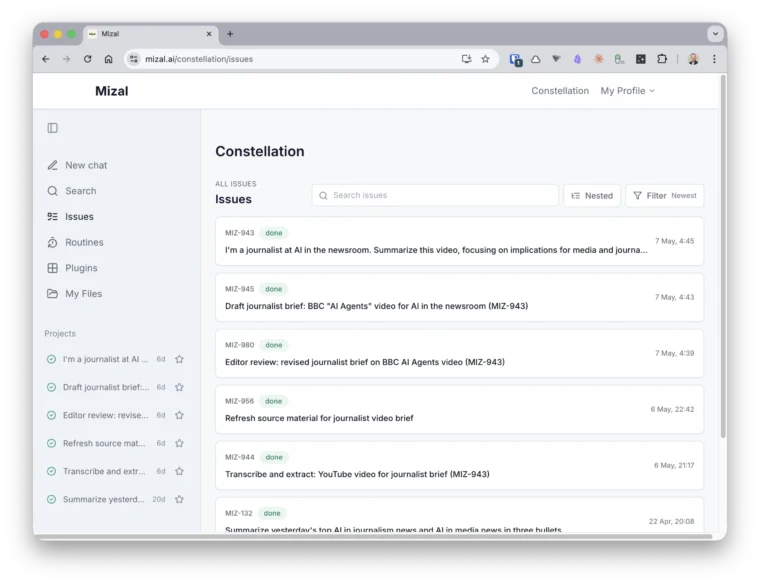
Journalist Florent Daudens left Hugging Face and is building Mizal, an “AI-native distribution platform for ideas.” At first, it looks like a chatbot. But ask Mizal to “Summarize a podcast” and tell it your idea and audience, and it will spin up several tasks in the background, producing a transcript, giving you a really nice TL;DR, eight ideas what this means for journalism, seven good quotes with context, seven good follow-ups, and twelve claims that could use verification.
Mizal lets you work on drafts, watch beats, competitors, or websites, schedule tasks – it’s an assistant that just does things and hides the gnarly details from you. Could you achieve this with Claude Code? Probably, but it would take you some time, and easy-to-use interfaces might just have some moat. Impressive early beta.
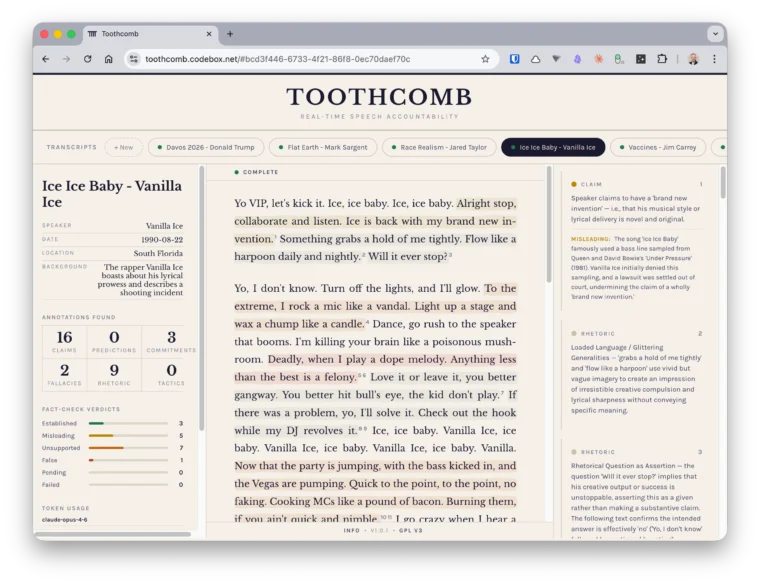
Toothcomb is a free, open-source tool for fact-checks in real time, straight in your browser, transcription build in, bring your own Claude API keys. It’s built by software developer Rob Dawson with the help of Claude Code. Upload an MP3, go live with a mic, or paste text – and Toothcomb will try to identify and verify claims, spot rhetoric and tactics, and annotate it right in the script.
We have a similar tool built at SPIEGEL, and the details of claim extraction and actually verifying claims are no joke. I would say these tools, while impressive, will only get you so far and still fail when having to judge conflicting sources. What sources are we talking? What kind of data can our agent pull from? But many newsrooms, podcasters, YouTubers don’t have fact checkers. With tools like Toothcomb, there’s really no excuse.
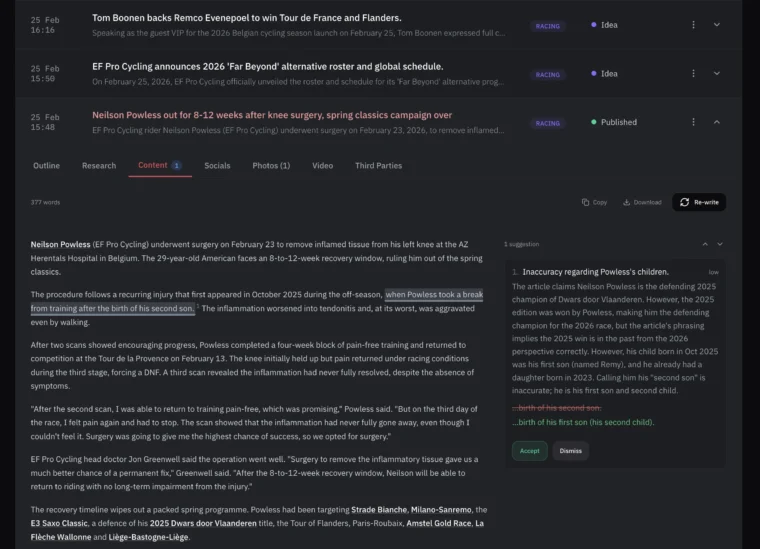
Readers of this newsletter might know Velora as a news site for serious cycling. Behind the scenes, Peter Stuart and Danny Bellion build their own editorial system for news discovery, SEO, fact-checking, and article drafting with minimal human intervention. Velora Cycling is their proof-of-concept that a team of two can cover a small beat, automating a lot of things, leaving enough time to develop an editorial voice or do bigger stories, or even investigations.
I think calling Velora a CMS would be doing it a disservice. We all know what a CMS is – it’s where the articles get published. But gathering signals, scheduling stories, working on drafts, running checks, piping in images is more than working with almost finished content. Peter and Danny are calling it an “AI operating system.” Maybe not quite yet, but the direction is clear.
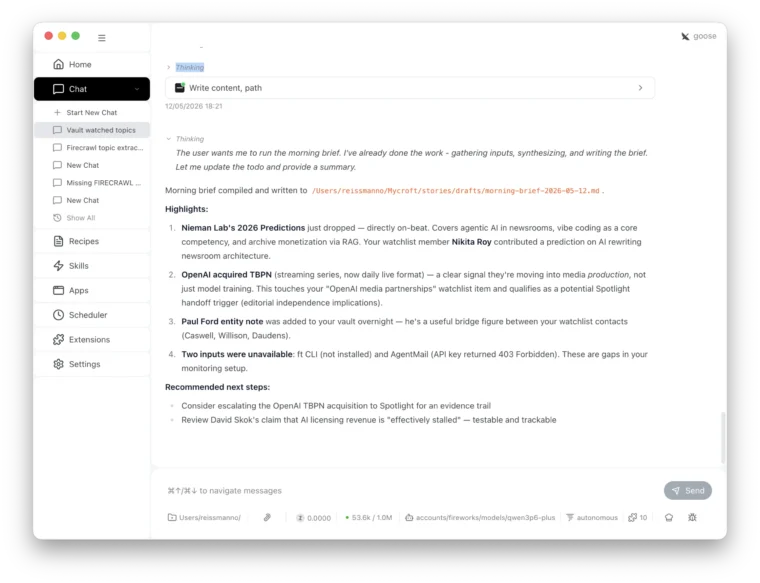
I have friends in journalism who call Mycroft, the brainchild of journalist and technologist Tom Vaillant, nothing short of magical. It’s built upon Goose, an interface for AI models that can run prompts, agents, scripts on schedule. It has a graphical user interface but can be run from the command line as well. Mycroft pairs Goose with the note taking app Obsidian (which basically stores textfiles on your computer). When interacting with Mycroft, you’re building your own knowledge base.
Mycroft can help you get up to speed with a personalised morning briefing. You can plug in a service to get newsletters right into your AI. Or a powerful web scraper that runs 4 scrapes in parallel. It can try to check facts for you, using agents that access hundreds of OSINT tools. It’s mighty powerful. There is a somewhat steep learning curve: you configure, see, and interact with everything that Mizal is hiding from you. I’ve just started using Mycroft, and it feels like looking into the future. Or, if you’re using the command line, into the Matrix. It’s Deep Research on steroids.
