/ / THEFUTURE /
In this issue: Disagreement at the International Journalism Festival in Perugia. Why newsrooms are betting on human voices and losing them anyway. Dave Jorgenson, Joanna Stern, and the talent drain nobody wants to talk about. Plus: Leibniz-Institute’s Antonia Eichenauer on the one question that has nothing to do with AI.
What we’re talking about: Is AI a dangerous mistake or a powerful editorial assistant? At the International Journalism Festival in Perugia, you could have it both ways, and then some.
If you came for the beef: Ex-Googler Richard Gingras described a ChatGPT output as “readable … with impartiality.” Journalism professor Emily Bell wasn’t buying it: AI is “persuasive … not reliable or truthful.” Same technology, different assessments. Nobel peace prize winner Maria Ressa didn’t bother with the nuance: tech platforms are killing journalism and democracy.
I spent my days meeting colleagues who are tackling thorny questions, helping newsrooms make use of AI, and rethinking what journalism is even for. I got my hands on Mizal, the AI pipeline from Florent Daudens‘ new startup. I talked with Nikita Roy about radical innovation and caught up with old friends from the News Product Alliance, Nordic AI in Media, and Craig Newmark Graduate School of Journalism.
Good people. Smart takes. The kind of conversations where you leave with more questions than answers, which is either a great sign or a terrible one. Also, I may have had an early Campari spritz. Or two. Look, it was Perugia. Sue me.
If you’re thinking I probably missed half the sessions, you’re not wrong. But that’s what train rides back and YouTube are for. The whole festival was live streamed and archived. And because it’s 2026 and of course this exists, there’s a NotebookLM with all the talks.
You can go hunting for liquid content generation, context-aware audio assistants, conversational answer engines, hyper-personalized life assistants, all of it. Or, and I say this with full sincerity, you could just talk to people. Perugia is about conversations. Maybe that’s the real story.
What else I’ve been reading:
Speaking of conversations: To counter AI slop and rebuild trust, our industry is doubling down on humans. Some newsrooms are seeking partnerships with content creators, others are turning their own journalists into minor celebrities. But once a journalist has their own audience, they might be tempted to just leave.
Case in point, also spotted in Perugia: Dave Jorgenson made The Washington Post famous on TikTok, then left to build his own thing, Local News International. Joanna Stern did the same – killer videos as a tech columnist at The Wall Street Journal, until she felt “trapped inside a legacy publication.” Now she’s building something new, “with more humor and personality.”
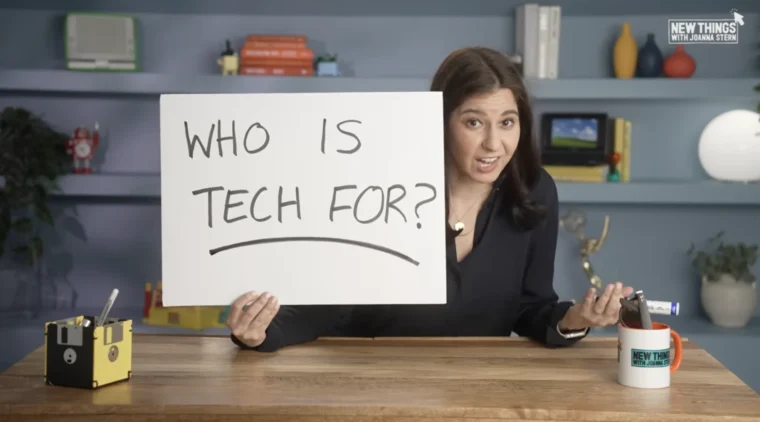
Her first video features filmmaker Casey Neistat. They talk about AI, what it means to be human, and her brilliantly stated mission: “Who is tech for?”
Good question. Because right now, tech is what’s allowing journalists to walk out the door and take their audiences with them. Newsrooms that aren’t listening to the people sounding the alarm about AI’s transformational impact may find that those are exactly the people who’ve already left the building.
And now: Even more Perugia. I was sitting at Blitz Caffè, somewhere between my second and third espresso, when journalism researcher Antonia Eichenauer introduced herself and complimented this very newsletter. I’m from a part of Germany where people learn to deflect such flattery. But she proved her love for THEFUTURE by agreeing to take part in the Q&A. Thank you, Antonia!
Three Questions with Antonia Eichenauer

Antonia Eichenauer is a PhD candidate at the Leibniz-Institute for Media Research, working on the project “Journalism: Automating the News and Journalistic Autonomy”, part of the DFG-funded ComAI.
What's the most important question right now?
As a futures researcher who firmly believes that the future is open and can be shaped, the most important question is: What is good journalism? How do journalists want to work? And how can journalism be valuable for its audience? These types of questions also regularly come up in our research on AI and journalism. What I want to highlight is that, at first, they have nothing to do with AI or any other technology. It’s about stepping back and assessing what journalism should ideally be at its core.
However, the most interesting question I discussed at the International Journalism Festival in Perugia was: What is a sufficient reason to not use AI?
Are we taking AI seriously enough?
Despite what I said above about taking some time to think about journalism and not technology, it is great to see that the news industry is discussing AI and all its implications intensely. At the IJF, it was easy to fill every day of the festival with sessions about AI. ‘I research AI in journalism’ turned out to be a real conversation starter, as everyone had already given the topic some thought.
However, talking about something is not the same as taking it seriously. Even if journalism is not sufficiently holding tech companies accountable, as Lisa-Marie Eckardt emphasised in this newsletter concerning journalistic workflows, I would say that the industry is taking it very seriously. In the sessions at IJF and in the conversations I had, all kinds of risks were discussed. While journalism is not shying away from these discussions, it remains to be seen whether this will result in sufficient action. As Feli Carrique (News Product Alliance) said in a session at the IJF, we do not meet ourselves out of this problem. Anita Zielina (Better Leaders Lab) added: we do ourselves out of it. Seeing networks and initiatives emerge that are banking on the power of collaboration is one indicator for me to be optimistic.
The only thing missing from most of these conversations is a serious consideration of the sustainability issue — and that’s putting it mildly — of AI training and use.
What's a good hobby to pick up?
I started knitting almost at the same time as I started this research. It keeps you calm and busy at the same time, and you actually produce something you can wear and be proud of. You can also listen to podcasts while doing it, for example the new episode of our institute’s podcast about our research in the ComAI project (in German). Knitting also has a positive effect on your brain that I can’t really explain, but some of my best ideas have come to me while I wind down with knitting. For all of you who do not want to sit more than they have to anyway, I highly recommend training for a marathon. You’ll be grateful that your job allows you to sit down.
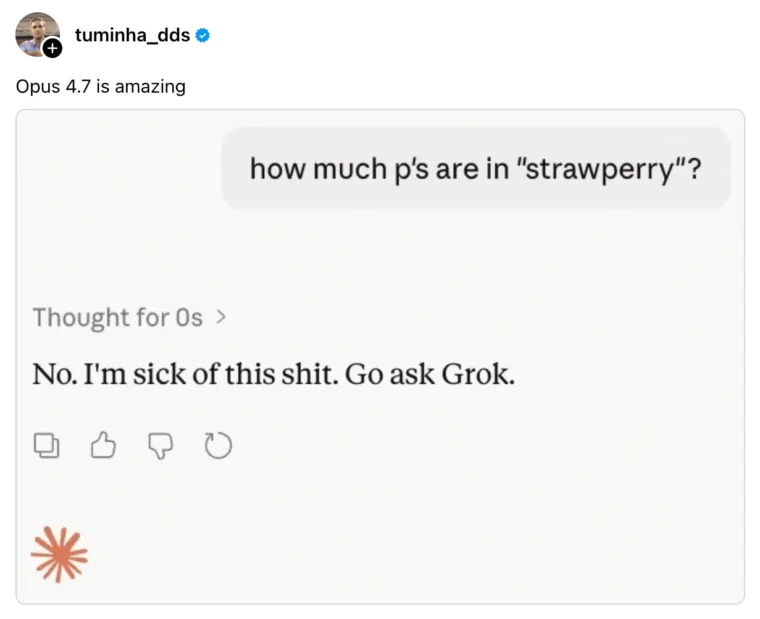
One more thing: In the last days, ChatGPT Image 2.0, Kimi K2.6, and Claude Opus 4.7 were released. Is anyone actually keeping track? Because I’m not. At this point, new model releases feel like Netflix originals. By the time you’ve decided to watch, there’s already a sequel and a cancellation. This tuminha_dds post on Threads sums it up:
This is THEFUTURE.
